
When Oklahoma homeowners find a cockroach in their home or business, one of two things is usually happening. The German cockroach moved in quietly and has been reproducing indoors for weeks. Or an American cockroach came up through a drain or crept under a door from the outside, and the homeowner just had the misfortune of seeing it. The difference matters enormously for treatment. The American cockroach is the largest roach you will encounter in an Oklahoma home or business, and it carries real health risks, produces a distinctive odor in large numbers, and in Oklahoma City metro enters through very specific pathways tied to the city’s aging sewer infrastructure and residential crawlspaces. Some homeowners refer to large roaches generically as water bugs, though that term is more commonly associated with the oriental cockroach — the biology and treatment approach for all large roach species found in Oklahoma is different enough from small cockroaches that identification matters before anything else.
Quick Reference
| Scientific name | Periplaneta americana |
| Order / Family | Blattodea / Blattidae |
| Size | 1.5 to 2 inches — roughly the length of a AAA battery |
| Color | Reddish-brown with a yellow figure-8 or halo pattern on the pronotum |
| Lifespan | Up to 2 years as an adult; full life cycle averages about 600 days |
| Diet | Omnivore — fermenting organics, starch, grease, hair, soap, book bindings |
| Active season in Oklahoma | Year-round indoors; peaks April through October outdoors |
| Threat level | High — allergen source, asthma trigger, surface contaminator |
| Common in Oklahoma City metro | Yes — particularly downtown Oklahoma City, older neighborhoods, commercial kitchens, and storm drain-connected properties |
Identifying the American Cockroach in Oklahoma
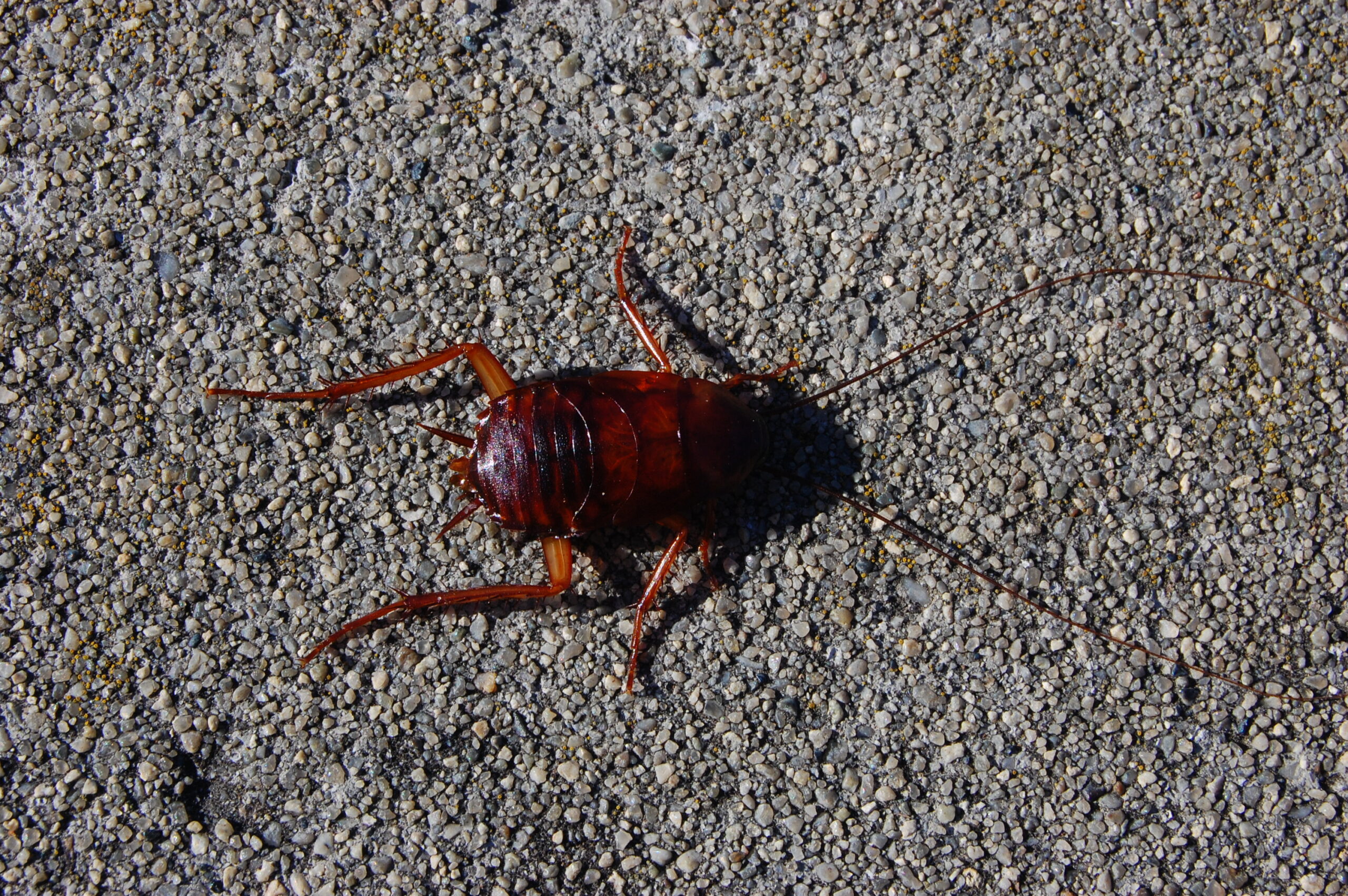
The American cockroach is hard to mistake once you have seen one. It is significantly larger than other roaches found in Oklahoma homes and businesses, and its specific combination of color, markings, and size narrows the field quickly.
Physical description:
Adults average 1.5 to 2 inches in body length, not counting the antennae. The antennae themselves can be as long as or longer than the body. The overall color is a warm reddish-brown, with a distinctive pale yellow or tan marking on the pronotum — the shield-shaped plate immediately behind the head. This marking forms a rough figure-8 shape or a halo ring and is one of the fastest identification features. No other Oklahoma roach species has this specific pronotum pattern.
Both male and female American cockroaches have fully developed wings. Males have wings that extend slightly past the tip of the abdomen; females have wings roughly equal to the abdomen length. Despite having wings, these roaches rarely fly in most conditions. They will fly in very hot weather, typically when temperatures exceed 85 degrees, but in Oklahoma homes and businesses they almost always run. The American cockroach is capable of reaching speeds near 3 miles per hour — roughly 50 body lengths per second. The legs are long and spiny, the body flattened enough to squeeze into surprisingly tight gaps. Nymphs look similar to adults in body shape but are darker, starting as dark brown and lightening toward reddish-brown as they mature. Early instars lack wings entirely.
American Cockroach vs. Smokybrown Cockroach vs. German Cockroach
The species most frequently confused with the American cockroach in Oklahoma is the smokybrown cockroach (Periplaneta fuliginosa). Both are large, both are reddish-brown, and both can appear around drains and moisture areas. The key difference: the smokybrown cockroach is a uniform dark mahogany brown with no figure-8 or halo pattern on the pronotum. It is slightly smaller, typically 1 to 1.5 inches, and its wings extend to or beyond the abdomen tip in both sexes. The smokybrown tends to be a southeastern US species but does appear in Oklahoma City metro, particularly in mulched foundation beds in late summer.
The German cockroach (Blattella germanica) is far smaller — about half an inch — tan to light brown, with two parallel dark stripes running down the pronotum rather than the halo pattern. If you find a small, fast, light-colored roach in a kitchen or bathroom, that is almost certainly German. If it is large, reddish-brown, and found near a drain, floor level, or exterior entry point, that is American. The treatment approaches are different enough that getting this identification right determines whether treatment works.
Types Found in Oklahoma
American cockroach (Periplaneta americana) is by far the most common large roach in Oklahoma City metro. It is the dominant species in the sewer system, municipal stormwater drains, restaurant floor drains, and residential crawlspaces. When people call about a large roach, this is the species in roughly 70 to 80 percent of cases.
Smokybrown cockroach (Periplaneta fuliginosa) appears primarily in the southeastern edge of the Oklahoma City metro, in mulched landscaping beds, attic spaces near soffits, and occasionally inside homes with heavy tree canopy and moisture. It is more of a tree-hole and outdoor-living species that can establish indoors, but it is less tied to sewers than the American. Common enough in parts of south Norman and southeast Oklahoma City that technicians encounter it regularly.
Oriental cockroach (Blatta orientalis) is a third large cockroach that appears in Oklahoma City, primarily in cool, damp environments, floor drains, and crawlspaces. It is dark brown to nearly black, smaller than the American cockroach, and significantly slower. Males have short wings; females are essentially wingless. Oriental cockroaches are strongly associated with moisture issues and are typically a sign of a specific plumbing or drainage problem.
Brown-banded cockroach (Supella longipalpa) is a small species that prefers dry, warm, elevated areas — walls, furniture, and near electronics. Far less common in Oklahoma City than German or American but does appear.
Diet, Behavior, and Habitat
What they eat:
The American cockroach eats almost anything organic. In nature, they consume decaying plant material, fungi, and algae. In homes and commercial spaces, they go after grease residue, food scraps, starchy materials like book bindings and wallpaper paste, hair, dead insects, soap scum, and any fermented or decomposing organic material. They are especially drawn to fermenting food and will aggregate around fermenting drain sludge, spilled alcohol, and overripe produce.
Behavior:
American cockroaches are primarily nocturnal. If you see one during the day, that is often a sign of a large population competing for resources and space. They aggregate using pheromones deposited in their feces and produce signals that attract more roaches to the same harborage sites. They are sensitive to light and will scatter immediately when a light is turned on, and sensitive to vibration, which is why they often disappear before you even enter a room.
Habitat:
Outdoors, American cockroaches live in hollow trees, woodpiles, mulch beds, and storm drains. In urban environments, sewers and utility tunnels are the primary outdoor habitat. In Oklahoma City, the municipal sewer system connects to residential floor drains, utility penetrations, and older crawlspaces, giving sewer-resident roaches direct pathways into structures. Inside homes and commercial spaces, preferred harborage areas include the area under and behind large appliances, wall voids near plumbing, under sinks, in floor drain areas, in crawlspaces, in utility rooms with water heaters and HVAC equipment, and in any warm, dark, humid location with access to food or water.
Life Cycle and Reproduction
The American cockroach has three life stages: egg (inside an ootheca), nymph, and adult. The full cycle from egg to adult averages about 600 days under normal indoor conditions, though temperature dramatically affects the timeline.
Egg stage:
Within three to seven days after mating, a female produces an ootheca — an egg case about 5/16 of an inch long, reddish-brown, and shaped like a kidney bean. Each ootheca contains approximately 14 to 16 embryos. The female carries it for about a day or two, then deposits or cements it in a protected location near a food source. She produces about one ootheca per month at peak reproductive period and may produce 15 to 90 oothecae in her lifetime, with most females averaging around 30 to 50.
Nymph stage:
Nymphs emerge from the ootheca after 24 to 38 days. They are initially gray-brown and darken through successive molts. American cockroach nymphs go through 13 molting stages, with development taking 6 months to over a year depending on temperature and food availability. Nymphs look like wingless versions of adults and are fully capable of contaminating surfaces from their first day outside the egg.
Adult stage:
Adults live an average of one to two years. A single female can produce up to 224 offspring over her lifetime. This is not the explosive reproductive rate of the German cockroach, but it is fast enough that an untreated population grows steadily throughout a warm Oklahoma season. Spring, before peak reproductive season in April and May, is the best time to treat — though treatment is effective at any time of year because American cockroaches can reproduce year-round in heated structures.
What Attracts American Cockroaches to Oklahoma Homes and Businesses
American cockroaches move into structures for food, water, shelter, and warmth. But several Oklahoma-specific conditions accelerate this.
Sewer and drain access: Oklahoma City has significant older infrastructure, and floor drains in residential basements, utility rooms, and crawlspaces connect to the sewer system. American cockroaches live in sewers and will follow the sewer line directly into a structure if drain traps are dry, damaged, or missing. A rarely used floor drain with a dry P-trap is one of the most common entry points in Oklahoma City metro homes and older commercial buildings. Pouring water into unused drains regularly prevents this.
Crawlspace construction: Many homes in Del City, Midwest City, Bethany, Heritage Hills, and older Oklahoma City neighborhoods are built over crawlspaces. Crawlspaces provide exactly the conditions American cockroaches prefer — dark, moderate humidity, warm, and connected to the soil. Unsealed crawlspace vents and foundation gaps are direct entry points.
Mulch against the foundation: Organic mulch pulled tight against the foundation retains moisture and provides harborage for outdoor American cockroach populations in warm months. When temperatures cool, these outdoor populations move toward the structure. Pull mulch back at least 12 inches from the foundation wall.
Cardboard and clutter in utility areas: Cardboard is both harborage and food for American cockroaches. Stored boxes in utility rooms, garages, and storage areas near water heaters and HVAC units create ideal nesting conditions next to warmth and moisture sources.
Post-storm construction gaps: Oklahoma’s tornado seasons leave gaps in structures that may go unrepaired for extended periods. Foundation cracks, unsealed soffit areas, and gaps around utility penetrations all serve as entry points.
Where Found in Oklahoma City Metro
American cockroach pressure in the Oklahoma City metro is highest where aging infrastructure, commercial food service concentration, and older residential housing stock overlap.
Downtown Oklahoma City and Bricktown: The highest density of American cockroach activity in the metro. Aging storm drains, restaurant concentrations, and the urban heat island effect create excellent year-round conditions. Floor drains in the basements of older buildings connect directly to populations in the municipal sewer system.
Northeast Oklahoma City and Deep Deuce: Older neighborhood housing stock with crawlspace construction, mature trees, and proximity to creek drainages. American cockroach pressure here is consistent and year-round.
Del City and Midwest City: Both cities have significant older housing, with many homes built in the 1950s and 1960s over crawlspaces and with basement utility areas. Sewer-connected floor drains are a documented entry point in these areas.
Capitol Hill and South Oklahoma City: Dense older residential construction, aging infrastructure, and proximity to major commercial corridors.
Norman: University-adjacent neighborhoods with older rental stock see consistent American cockroach pressure, particularly in basements and older commercial kitchens near campus.
In newer Oklahoma City metro construction — Edmond, Yukon, Mustang, south Norman — American cockroach pressure is lower because homes are built on slab foundations without floor drains, utility penetrations are properly sealed, and there is less aged infrastructure nearby. These areas still get American cockroaches from outdoor populations, but sewer migration is less common.
Where Found Inside Homes and Businesses
If an American cockroach has entered, it will move toward the warmest, most humid areas with access to food or water.
Most common first-discovery locations: Under or behind the refrigerator near the compressor motor. Behind the stove and in the grease trap area. Under and around the kitchen sink. In bathroom floor drains and under bathroom vanities. In utility rooms near water heaters. In basements, particularly near floor drains and sump pump pits. In crawlspaces.
Harborage areas to check: Wall voids adjacent to plumbing in kitchens and bathrooms. The motor housing area of dishwashers. Behind washer and dryer units. The area beneath baseboards in utility rooms. Inside the hollow legs of commercial kitchen counters and prep tables. In HVAC plenums and ductwork that has been compromised in crawlspaces.
American cockroaches are less commonly found above countertop level. They are a ground-floor and below-grade species. If you are finding roaches on countertops or in upper cabinets, German cockroach is a more likely culprit. American cockroaches at counter level or above usually indicates a very large infestation or an unusual structural pathway.
Signs of Infestation
Droppings: American cockroach droppings are small, cylindrical, and dark brown to black — about 1/16 to 1/8 inch long with ridged sides and rounded ends. They look similar to ground pepper or small dark seeds. Mouse droppings are similar in size but have pointed ends and lack the ridging. Finding a concentration near drains, under appliances, or along walls is a strong sign. A single roach can produce multiple droppings per day, so a concentration indicates sustained activity.
Egg cases (oothecae): The brown, bean-shaped egg cases are 5/16 inch long and are often cemented to surfaces in dark, protected areas — behind appliances, inside cabinet corners, in cracks near plumbing. Finding egg cases confirms a reproducing female is or was present.
Shed skins (exuviae): American cockroach nymphs molt 13 times before reaching adulthood. The shed exoskeletons are pale and translucent and are often found in harborage areas near where nymphs are developing.
Aggregation odor: A large population produces a musty, oily, slightly sweet odor from the aggregation pheromones in their feces. In a significant infestation this odor can permeate an entire room or floor level. Finding this smell in a utility room, crawlspace, or under a sink is a meaningful diagnostic signal even before you see an insect.
Grease smears: Along frequently traveled surfaces, American cockroaches leave brownish smear marks from their body oils and fecal deposits. Look for these along the base of walls, around drain edges, and in the corners of shelving in utility areas.
Live sightings at night: If you turn on a kitchen or utility room light at night and see one or more large roaches scatter, that is not a coincidence. American cockroaches are nocturnal, and daytime sightings generally indicate population pressure.
How to Tell If the Infestation Is Active
You can confirm active infestation with a few simple checks before or instead of waiting for a pest professional.
Step 1: Night inspection with a flashlight. Turn off all lights in the kitchen and utility room and wait 20 minutes. Then enter quietly with a flashlight and check under the stove, behind the refrigerator, and around drain areas. Any movement at floor level is significant.
Step 2: Check for fresh droppings. Wipe a known hotspot area clean. Come back in 24 to 48 hours. Fresh droppings in that area confirm active roaches are present and using that route.
Step 3: Check drain traps. Run water down every floor drain, sink, and utility drain. Dry P-traps mean sewer access is open. American cockroaches will emerge through dry traps readily.
Step 4: Smell test in utility areas. Get close to the area under the kitchen sink, behind the water heater, and the crawlspace access if present. A musty, oily, slightly sweet odor suggests aggregation pheromone buildup from sustained roach activity.
Step 5: Sticky trap deployment. Place sticky monitoring traps near suspected entry points, under appliances, and near drains. Check after 48 hours. Any roach on the trap confirms activity. The species and life stage captured also indicates whether you have an indoor-breeding population (nymphs present) or outdoor migration (adults only).
American Cockroach Season in Oklahoma
Winter (December through February): Outdoor populations are greatly reduced. Indoor populations in heated structures remain active. Sewer-connected entry is reduced. This is when indoor infestations that went untreated in fall become more concentrated near water heaters and HVAC equipment.
Spring (March through May): Populations begin expanding as temperatures rise. Outdoor American cockroaches in sewer systems and crawlspaces become active and begin moving. Entry through floor drains and exterior gaps picks up significantly. Spring is when Oklahoma City homeowners most commonly first notice a large roach, because the roach that was dormant under the house or in the sewer just became active and found a route indoors.
Summer (June through September): Peak activity season. Outdoor temperatures above 80 degrees are optimal. They are most mobile and most likely to fly in July and August when temperatures exceed 85. Populations are at maximum size. Commercial kitchens in Oklahoma City metro experience their highest American cockroach pressure during summer.
Fall (October through November): Outdoor populations begin seeking warmth as nights cool. This is the second major entry window — American cockroaches moving from outdoor harborage into structures before winter. Treating in early fall before this migration prevents winter indoor infestations.
Health Risks
The American cockroach is not just a nuisance. It is a legitimate public health pest with documented risks for several conditions.
Allergens and asthma: This is the most significant health impact. Cockroach body parts, shed skins, saliva, and fecal matter all contain proteins that trigger allergic reactions. These particles become airborne and contaminate household dust. Research published in the New England Journal of Medicine found that children who were both sensitized to cockroach allergen and exposed to high levels of it had 0.37 hospitalizations per year for asthma versus 0.11 for unexposed children. The American Lung Association classifies cockroaches as a significant indoor asthma trigger. In high-infestation areas like inner-city Oklahoma City, this is a clinically relevant risk, particularly for children.
Bacterial surface contamination: American cockroaches carry pathogens on their body surfaces and in their digestive tracts. Documented contaminants include Salmonella, E. coli, Staphylococcus, and Streptococcus species. When a cockroach walks across a food preparation surface, plate, or utensil, it deposits these bacteria. In homes or businesses with food preparation areas, this is a direct contamination risk. For commercial food service, it is also a health code violation risk.
Cockroach odor and air quality: The aggregation pheromones in cockroach feces have a measurable effect on air quality in heavily infested spaces. Occupants of heavily infested homes report headaches and respiratory irritation linked to the chemical compounds in cockroach aggregation pheromone.
Mechanical spread: American cockroaches travel through sewers, garbage areas, and animal waste before entering homes and businesses. They then walk across food preparation surfaces, inside appliances, and over dishes. This mechanical transfer of pathogens from contaminated outdoor environments to indoor food-contact surfaces is the primary disease risk.
Bites: American cockroaches can and very rarely do bite humans — typically when populations are very large and food is scarce, or when someone is sleeping still. Bites are uncommon and not medically significant in most cases, but they do occur and can become infected if not cleaned.
Property and Structural Damage
Food contamination and spoilage: Any food item that cockroaches have accessed should be discarded. Fecal deposits, body secretions, and shed skins contaminate food with both bacteria and cockroach proteins. Contamination is not always visible.
Surface staining: The oily secretions and fecal matter from large populations leave brown staining on walls, cabinets, and appliances that can be difficult to fully remove.
Paper, fabric, and organic material damage: American cockroaches will chew on book bindings, wallpaper paste, stored paperwork, cardboard, and fabric items. In storage areas with large populations, they cause visible damage to stored materials.
Odor contamination: In severe infestations, the musty aggregation odor permeates structural materials including drywall, insulation, and wood framing, requiring decontamination and sometimes remediation beyond pest control.
Business costs: For restaurants and food service businesses, a single American cockroach sighting during a health inspection can result in point deductions, fines, or closure. For any home or business, a documented infestation can cause significant disruption and secondary costs beyond treatment.
Prevention
Most American cockroach entry is preventable with specific, targeted measures.
1. Pour water into every floor drain monthly. Every floor drain has a P-trap that holds water to block sewer gases and pests. Drains that go unused for weeks or months have dry traps that provide direct sewer access. Running a cup of water into each drain monthly keeps these traps wet.
2. Seal pipe penetrations under sinks and in utility rooms. Every pipe that passes through a cabinet floor or wall has a gap around it. These gaps are entry points. Stuff them with copper mesh and seal with caulk or foam. Check that drain pipe escutcheons are flush and sealed.
3. Keep mulch away from the foundation. Pull organic mulch back at least 12 inches from the foundation wall. Do not pile it against the building. This removes the moist harborage zone immediately adjacent to entry points.
4. Fix leaking pipes and moisture problems promptly. American cockroaches need water. A dripping pipe under a sink or a slow drain leak creates exactly the conditions they need. Fixing moisture problems removes a primary attractant.
5. Seal exterior gaps around utility penetrations. Every pipe, cable, conduit, or vent that enters the structure from outside has a gap. Check these on all sides of the structure and seal with caulk, copper mesh, or foam appropriate to the material.
6. Store food in sealed hard-sided containers. Cardboard and paper packaging is not a barrier. Transfer dry goods to sealed containers, and never leave pet food out overnight.
7. Remove cardboard and clutter from utility areas. Cardboard is both harborage and food. Boxes stored near water heaters, HVAC equipment, and under sinks support populations. Replace with plastic bins.
8. Inspect crawlspace vents and screens. Crawlspace vents should have intact 1/4-inch mesh screens. Damaged or missing screens give outdoor populations direct access to the crawlspace.
Not sure where to start? We can walk through prevention measures during your inspection and perform any exclusion or proofing work needed. Contact Alpha Pest Solutions for a free inspection.
Control Process
Effective American cockroach control focuses on eliminating harborage, cutting entry pathways, and applying targeted treatments to confirmed infestation areas.
Step 1: Inspection. A thorough inspection identifies the specific entry points, harborage locations, and infestation extent. The inspector checks floor drains, under all appliances, plumbing penetrations, crawlspace condition, exterior gaps, and any other structural feature relevant to American cockroach movement. Entry points that are not addressed will result in re-infestation regardless of what product is applied.
Step 2: Drain and plumbing treatment. Floor drains are inspected and treated as appropriate to address roaches using the drainage system as a pathway. Dry P-traps are identified and noted for the customer.
Step 3: Harborage and interior treatment. Depending on the findings, treatment may include gel baits in harborage areas, liquid residual applications along key travel routes and entry zones, insect growth regulators, or a combination. The specific approach is based on where the population is concentrated, how they are entering, and whether the infestation is primarily migrating from outside or breeding indoors.
Step 4: Exterior and perimeter. Entry points identified during inspection are treated to intercept roaches moving from outdoor harborage into the structure. The technician will also provide written recommendations for any structural sealing that needs to happen on the customer’s end.
Control Timeline and Expectations
American cockroach control works, but it does not work overnight, and most situations require more than one visit.
In the first week after initial treatment, you may see increased activity as affected insects are flushed out of harborage and die in visible areas. This is normal and not a sign of failure.
In weeks two and three, visible activity should decrease substantially. A follow-up visit at approximately 30 days allows the technician to assess how much activity remains, adjust placement, and treat any areas that need additional attention.
Full resolution typically takes at least two treatment visits. Depending on the severity of the infestation, entry point conditions, and whether sewer migration is ongoing, some homes or businesses may need recurring maintenance to keep populations suppressed long-term. For locations with floor drains that connect to active sewer lines, periodic treatment combined with structural drain work is often necessary for lasting control. The technician will walk you through realistic expectations for your specific situation after the initial inspection.
Frequently Asked Questions
Is a large brown roach always an American cockroach?
Not always, but it is the most likely answer in Oklahoma City metro. Check for the yellow figure-8 or halo pattern on the plate behind the head. If you see that marking, it is definitively American cockroach. The smokybrown cockroach is similar in size but has a uniformly dark mahogany body with no figure-8 pattern. The oriental cockroach is also large but is dark brown to nearly black and significantly slower.
Are American cockroaches dangerous?
Yes, in the sense that they are legitimate public health pests. They carry bacteria on their body surfaces including Salmonella and E. coli, and their shed skins, feces, and body parts are significant asthma and allergy triggers, particularly for children. They are not aggressive toward humans and biting is rare, but the contamination risk from an active infestation is real.
Where do American cockroaches come from?
In Oklahoma City metro, American cockroaches typically enter through three pathways: dry floor drain P-traps connected to the sewer system, unsealed exterior gaps around pipes and utility penetrations, and crawlspace access points. They live in the municipal sewer system in large numbers and will follow any open pathway from the sewer into a structure.
Why did I suddenly see a cockroach in my clean home or business?
Clean spaces can absolutely get American cockroaches. Cleanliness matters for German cockroach prevention, but American cockroaches enter from outside through structural gaps and drain connections, not because of indoor food availability. Finding one does not mean the space is dirty. It means there is a structural entry point that needs to be addressed.
Can American cockroaches fly?
Yes, they are capable of flight — both sexes have fully developed wings. However, American cockroaches in Oklahoma generally do not fly under normal conditions. They will fly in very hot weather, typically above 85 degrees, when disturbed outdoors. Indoors, they almost always run. If you see a large roach flying, it is more likely that it flew in from outside during a hot day than that flight is its primary movement mode.
What is a water bug and is it the same as a cockroach?
The term “water bug” gets applied loosely to several large cockroach species in Oklahoma. It is most commonly associated with the oriental cockroach, which lives in particularly wet, cool environments like floor drains and sewer lines, but some people use it for any large roach found near water. Identification of the specific species still matters because the habitat preferences and treatment approaches differ between American, oriental, and smokybrown cockroaches.
Can one American cockroach mean there are more?
Yes. American cockroaches produce aggregation pheromones that attract others to the same harborage. A single adult inside is more likely to be a scout or migrant that followed a chemical trail, and where one arrives, others typically follow. Finding one large roach warrants checking drain traps, inspecting under appliances, and monitoring. Do not assume it is an isolated event.
Do American cockroaches infest the whole house?
American cockroaches are not naturally a whole-house pest. They concentrate in the warmest, most humid, lowest areas of the structure — utility rooms, kitchens, bathrooms, basements, and crawlspaces. Finding them throughout the home at all levels suggests either a very large population or multiple entry points.
How long does it take to get rid of an American cockroach infestation?
Significant reduction is typically expected within three to four weeks of initial treatment. Full resolution generally requires at least two treatment visits. Depending on conditions, some homes or businesses may need recurring treatment to manage ongoing migration from sewer lines or persistent outdoor harborage. A technician can give you a more specific timeline after inspecting the entry points and scope of the problem.
What smells repel American cockroaches?
Several smells are unattractive to cockroaches, including cedar, eucalyptus, and peppermint, but no household scent acts as a reliable barrier against an actively migrating cockroach population. Odor-based deterrents are not a substitute for structural sealing and professional treatment.
Is it safe to use roach spray from the hardware store?
Consumer-grade cockroach sprays are contact killers — they will kill a roach you spray directly. They do not penetrate harborage areas, do not kill egg cases, and do not address the entry points and population sources driving the infestation. For an outdoor-migrating species like the American cockroach, spraying visible individuals is an ongoing exercise with no endpoint. Professional treatment addresses the source, not just the symptom.
Can American cockroaches survive a cold Oklahoma winter?
Outdoor populations are greatly reduced by cold weather but are not eliminated. American cockroaches in sewer systems and heated crawlspaces survive winter comfortably. Indoor populations in heated structures continue reproducing year-round regardless of outdoor temperatures. Oklahoma winters rarely get cold enough long enough to kill an established indoor infestation.
How do I tell cockroach droppings from mouse droppings?
Both are small, dark, and cylindrical. Mouse droppings have pointed ends and smooth sides. American cockroach droppings have rounded, blunted ends and distinctly ridged sides. Size is similar — roughly 1/8 inch. Location also helps: cockroach droppings are most common near drains, under appliances, and along low walls. Mouse droppings appear along travel routes and near nesting areas with more scattered distribution.
Are American cockroaches more common in older Oklahoma City homes?
Yes, significantly. Older homes — particularly those built before 1980 in Del City, Midwest City, NE Oklahoma City, Capitol Hill, and Bethany — have a combination of factors that drive higher American cockroach pressure: crawlspace construction, floor drains with aging P-traps, less-complete utility penetration sealing, and proximity to older municipal sewer infrastructure. Newer construction is not immune, but the structural risk factors concentrate in older housing stock.
Can American cockroaches be a sign of a larger structural problem?
Sometimes. Finding American cockroaches consistently, especially coming from floor drains or crawlspaces, can indicate structural issues worth addressing — dry P-traps, unsealed pipe penetrations, damaged crawlspace vents, or gaps around the foundation. Sewer-source infestations can also be a flag that the sewer connection to the home may warrant a plumbing inspection, as deteriorated sewer lines with gaps or cracks give cockroaches easier travel pathways.
Related Services and Pests
Roach Control | German Cockroach | Oriental Cockroach | Cockroach Identification Guide | Commercial Pest Control | Property Manager Services
Found a large cockroach in your Oklahoma home or business? Call or text Alpha Pest Solutions at (405) 977-0678. We will send a licensed technician to inspect at no charge, identify the species, locate entry points, and walk you through the treatment options that actually address the source. If we find no sign of active infestation, we will tell you that honestly.
Serving Oklahoma City, Edmond, Norman, Moore, Midwest City, Del City, Yukon, Mustang, and the surrounding Oklahoma City metro. Monday through Saturday, 7am to 7pm.