
Bed Bugs vs. Bat Bugs vs. Bird Mites
If you are finding unexplained bites, seeing small insects or crawling specks near your bed or walls, or inspecting for bugs and getting confused by what you are finding — this page is for you.
These three pest types are routinely confused with each other. They are also the three most common explanations for what gets incorrectly written off as “delusory parasitosis” — the medical term for the belief that bugs are present when no bugs can be found. Getting the identification right changes everything: the treatment for each is completely different, and treating for the wrong one is wasted money and continued suffering.
In the Oklahoma City metro, bed bugs are by far the most common of these three. Bat bug infestations do occur but are significantly less frequent — Oklahoma City does not have the bat colony density that would make bat bugs a common residential problem. Bird mites are tied specifically to active or recently abandoned bird nests on or in the structure.

Bed Bug (Cimex lectularius)

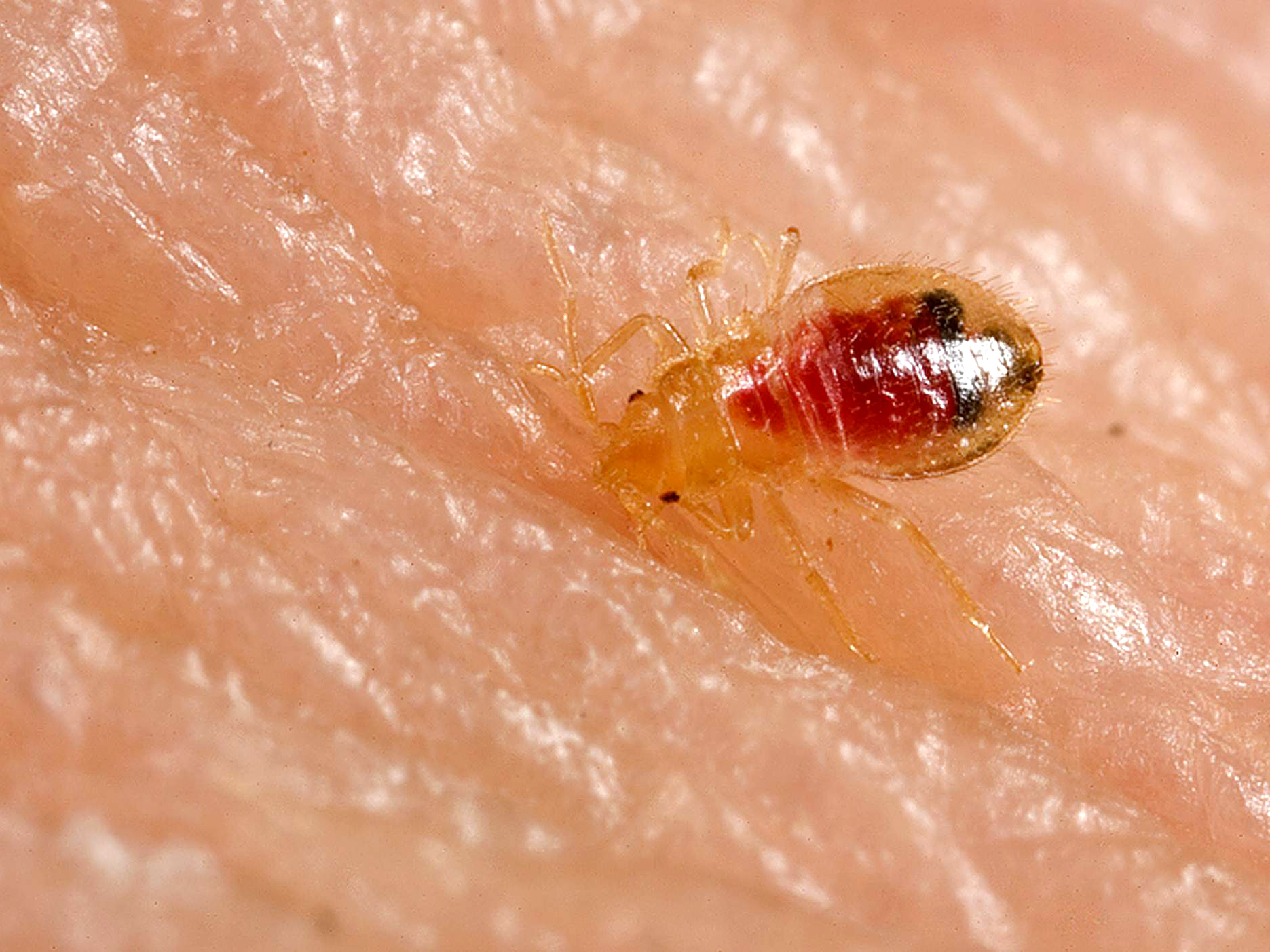
What They Look Like
Adult bed bugs are 4 to 5 millimeters long — roughly the size of an apple seed. They are flat, oval, and reddish-brown when unfed. After feeding, they become engorged, more elongated, and darker red to purplish-brown. Nymphs (juveniles) are smaller and translucent to pale yellow, becoming darker as they develop through five molting stages.
Bed bugs are visible to the naked eye. Adults can be found and identified without magnification if you know what to look for.
Signs of Bed Bug Infestation
- Blood stains (small rusty spots) on sheets or pillowcases from crushed bugs
- Dark fecal spots — tiny black or dark brown dots on mattress seams, box spring, headboard, and surrounding walls; the spots bleed into fabric like a felt-tip pen
- Shed skins — translucent casings left behind as nymphs molt through 5 developmental stages
- Live bugs — in mattress seams and tufts, behind headboards, inside box spring corners, behind outlet covers near the bed, in picture frame backs, along baseboard cracks
- Bites — typically linear or clustered, often on exposed skin during sleep (arms, neck, legs). Not everyone reacts to bed bug bites; roughly 30% of people show no skin reaction, which is why one person in a household can be heavily bitten while another shows nothing
IMAGE: Macro photo of bed bug fecal spots and shed skins on a mattress seam. Caption: “Fecal spots and shed skins on a mattress seam. These are reliable physical evidence of bed bug activity.”
Where They Come From
Bed bugs are hitchhikers, not a sign of uncleanliness. They travel on luggage, secondhand furniture, clothing, and through wall voids in multi-unit housing. Hotels, apartment complexes, college dormitories, and used furniture are the most common introduction sources in the Oklahoma City area.
Bat Bug (Cimex adjunctus)

What They Look Like: The Problem
Here is the core issue with bat bugs: they look almost exactly like bed bugs. Same size, same shape, same color, same general behavior. The defining differentiator is the length of the marginal fringe hairs on the pronotum (the plate behind the head). In bat bugs, these hairs are distinctly longer than the width of the eye. In bed bugs, they are equal to or shorter than the eye width. Reliable differentiation requires 20 to 50x magnification and a comparison reference.
Why It Matters
Bat bugs and bed bugs require different treatments. Bat bugs live in bat roosts — typically attics, wall voids, or behind siding where bats have been roosting. They feed on bats. When the bats leave (seasonally or after exclusion), the bat bugs move down into the living space looking for an alternative host. This is when people start getting bitten.
If you treat only the living space and do not address the bat colony and roost, the bat bugs will keep coming. In Oklahoma City, bat infestations are relatively uncommon, so if you have a biting insect problem, bed bugs are the far more likely explanation. But if there is a known bat history in the structure and conventional bed bug control has not resolved the problem, bat bugs should be investigated.
Signs That Point to Bat Bugs Rather Than Bed Bugs
- You have had bats in your attic or have seen bats exiting the structure
- Bugs appear seasonally — often in spring or fall when bat colonies shift or leave
- Traditional bed bug control is applied but bites continue
- Bugs are appearing in upper areas of walls, near ceiling junctions, or around attic access points rather than only near the bed
- Pest control inspection of the bed and typical harborage areas comes up clean
Correct Treatment Protocol
- Confirm bat presence and locate the roost
- Have bats professionally excluded (bats are federally protected; timing matters — exclusion cannot occur during maternity season, typically May 15 through August 15 in Oklahoma)
- After confirmed bat removal, sanitize and treat the roost area
- Address bat bugs in the living space
- Seal all bat entry points
Treating only for insects in the living space while skipping the bat colony is the most common and expensive mistake.
IMAGE: Bats exiting a structure at dusk through a gap near the roofline. Caption: “If bats have been roosting in the structure, bat bugs are a possible explanation for biting insects — but confirm bat presence first.”
Bird Mite (Dermanyssus gallinae and Ornithonyssus sylviarum)
IMAGE: Macro photo of bird mites — nearly invisible white to gray specks — on a white surface, with a dime for scale. Caption: “Bird mites at scale. They are less than 1mm and often barely visible as moving specks without magnification.”
What They Look Like
Bird mites are arachnids — 8-legged, not insects. Adults are less than 1 millimeter — barely visible to the naked eye, often appearing as tiny moving specks or a faint crawling sensation on the skin. They are translucent to pale gray when unfed. After feeding on blood, they turn darker red to black.
Dermanyssus gallinae (chicken or red mite) is primarily nocturnal and hides in cracks during the day. Ornithonyssus sylviarum (northern fowl mite) is the more common species in Oklahoma residential settings and stays on the host more consistently.
Where They Come From
Bird mites live on birds — primarily sparrows, starlings, pigeons, and swallows that nest on or in structures. They also occur in chicken coops and on poultry. When a bird nest is abandoned or young birds fledge and leave, the mites lose their host and begin searching for an alternative. This drives them into the living space.
Common scenarios in Oklahoma City:
- Sparrows or starlings nesting in attic or soffit vents; nest abandoned in summer
- Pigeons roosting on window ledges or AC units
- Bird nests in fireplace dampers or chimney caps
- Window AC units with bird activity behind the unit
People describe the sensation as crawling, biting, or itching —”often without seeing anything clearly. This combination frequently leads to misdiagnosis, including being told there are no bugs.
Bird Mites vs. Bed Bugs: Key Differences
| Bird Mites | Bed Bugs | |
|---|---|---|
| Size | <1mm, barely visible | 4–5mm, visible |
| Legs | 8 (arachnid) | 6 (insect) |
| Visible to naked eye | Barely —”moving specks | Yes, clearly |
| Time of bites | Anytime, day or night | Primarily night |
| Source | Bird nest in or on structure | Hitchhiked in |
| Fecal spots on bedding | No | Yes |
| Survives on humans | No — cannot complete life cycle | Yes |
Can Bird Mites Live on Humans?
Bird mites cannot complete their life cycle on humans. They will bite and cause irritation, but they cannot reproduce on a human host. A bird mite infestation, while genuinely miserable, is self-limiting once the bird host is removed — if you also address the mites in the living space.
Correct Treatment Protocol
- Identify and locate the bird nest or roost
- Remove the nest (after confirming birds are not actively nesting — removal of active nests of most songbirds is federally regulated under the Migratory Bird Treaty Act)
- Treat the area where the nest was located
- Address mites that have migrated into the living space
- Seal the entry point to prevent re-nesting
Side-by-Side Comparison
| Feature | Bed Bug | Bat Bug | Bird Mite |
|---|---|---|---|
| Size | 4Ҁ�5mm | 4–5mm | <1mm |
| Class | Insect (6 legs) | Insect (6 legs) | Arachnid (8 legs) |
| Color unfed | Reddish-brown | Reddish-brown | Translucent/pale |
| Visible to naked eye | Yes | Yes | Barely |
| Primary host | Humans | Bats | Birds |
| Survives on humans | Yes | Poorly | No |
| Fecal spots on bedding | Yes | Sometimes | No |
| Key indicator | Fecal spotting, shed skins, classic harborage sites | Bat history, seasonal appearance, failed bed bug control | Bird nest in/on structure, daytime biting, barely-visible specks |
| Pronotum fringe hairs | Short (≤ eye width) | Long (> eye width) | N/A |
| Treatment approach | Heat or chemical treatment; EPA-registered protocols | Address bat colony first | Address bird source first |
| Common in Oklahoma City | Very common | Uncommon | Situational |
When the Answer Is “None of the Above”
If you have had a thorough inspection, submitted specimens for identification, treated appropriately for the identified pest, and you are still experiencing biting or crawling sensations — there is another possibility that deserves honest discussion.
Delusory parasitosis (also called delusional infestation) is a condition in which a person genuinely experiences sensations of crawling or biting without an identifiable insect or mite cause. It is a real medical condition recognized in the DSM-5, not a dismissal. The sensations are real; the cause is neurological, not entomological.
This is covered in full on the Delusory Parasitosis library page. It is relevant here because bed bugs, bat bugs, and bird mites are the three most common misdiagnoses that precede a correct DP identification — and it is critical that all three are rigorously ruled out before arriving at that conclusion.
IMAGE: Technician using a flashlight and magnifier to inspect a mattress seam. Caption: “A thorough inspection is the starting point. Identification determines treatment. Getting these wrong costs time and money.”
When to Call Alpha Pest Solutions
Call or text (405) 977-0678 if:
- You are finding bites you cannot explain and cannot identify the source
- You have had bat activity in your structure and are now experiencing biting insects
- You have bird nests on or in your structure and are experiencing crawling or biting sensations
- You have been treated for bed bugs and the problem continues
- You need a thorough inspection and honest assessment of what you are dealing with
We serve Oklahoma City, Edmond, Norman, Moore, Midwest City, Del City, Yukon, Mustang, and the surrounding Oklahoma City metro. Monday through Saturday, 7am to 7pm.
Frequently Asked Questions
Can I identify which bug I have on my own?
For bed bugs specifically, a careful inspection following published protocols can yield a reliable answer — fecal spotting, shed skins, and live bugs in mattress seams are hard to miss once you know what to look for. For distinguishing bat bugs from bed bugs, no — this reliably requires magnification and a reference key. Bird mites can often be confirmed by identifying the bird source. When in doubt, collect a specimen (tape sample or sealed container) and have it professionally identified or submitted to the OSU Extension Insect Diagnostic Lab.
I’ve been told I have bed bugs but treatment isn’t working. What now??
The two most common explanations: (1) incomplete treatment — bed bugs are highly resilient and require comprehensive protocols covering all harborage sites; (2) misidentification — if there is any bat history in the building, bat bugs should be ruled out. Request a re-inspection with specimen examination.
Do bird mites or bat bugs survive in the absence of their host?
Both have limited survival without their preferred host. Bird mites die within a few weeks without a bird host — but during that window they are actively seeking alternatives and biting. Bat bugs survive longer and can persist in wall voids and roost areas for months. Neither establishes a self-sustaining population on humans.
How do I collect a specimen for identification?
Use clear tape pressed against the surface where you see the pest. Place the tape sticky-side-down on a white card or in a small ziplock bag. For specimens you can pick up, a small sealed container works. Label it with the date and location where it was found. The OSU Extension Insect Diagnostic Lab in Stillwater accepts samples for identification. Alpha Pest Solutions can also have specimens examined.
Related Library Pages and Services
- Delusory Parasitosis
- Mites
- Bed Bug Service
- Wildlife Control
- Wildlife and Rodent Proofing
- Attic Remediation
Identification criteria from University of Florida IFAS Extension, Purdue University Extension, and CDC documentation. Bat exclusion timing guidelines from Bat Conservation International and Oklahoma Department of Wildlife Conservation.