
Quick Reference
| Scientific Name | Peromyscus maniculatus |
| Classification | Mammalia / Rodentia / Cricetidae |
| Size | Body 2.75–4 inches; tail roughly equal to body length; total 5–8 inches |
| Weight | 0.5–1.2 oz |
| Color | Reddish-brown to grayish-brown back; sharply contrasted white belly and feet; bicolored tail (dark above, white below) |
| Lifespan | 1–2 years in the wild; up to 5 years in protected conditions |
| Diet | Omnivore; seeds, nuts, insects, berries, fungi; caches food for winter |
| Reproduction | 2–4 litters per year, 3–8 pups per litter; sexually mature at 5–7 weeks |
| Active Season in Oklahoma | Year-round; highest structural entry pressure September through November |
| Threat Level | High — primary carrier of Sin Nombre hantavirus, the cause of Hantavirus Pulmonary Syndrome (HPS) |
| Common in Oklahoma City Metro | Present throughout — most common in rural-adjacent properties, outbuildings, new construction, and wooded suburban areas |
The deer mouse is one of the most common small rodents in North America — and one of the most medically significant. It is the primary reservoir host for Sin Nombre hantavirus, the pathogen responsible for Hantavirus Pulmonary Syndrome (HPS), a serious respiratory illness with a case fatality rate approaching 40 percent according to the CDC. In Oklahoma, hantavirus cases have been documented, and deer mice are present throughout the state in rural, suburban, and urban-edge environments. Unlike house mice, deer mice are not primarily a city pest — they are most common at the edge of developed and natural areas: wooded lots, rural properties, sheds, outbuildings, new construction sites, and homes adjacent to open fields or creek corridors. You do not need to handle a deer mouse to be exposed to hantavirus. Breathing dust from dried urine, feces, or nesting material in an enclosed space where deer mice have been active is sufficient for transmission. If you have found deer mouse activity in an attic, crawlspace, outbuilding, or enclosed storage area, treat the cleanup as a health concern before a pest control concern. Alpha Pest Solutions serves Oklahoma City, Edmond, Norman, Moore, Midwest City, Del City, Yukon, Mustang, and surrounding communities.
Identifying Deer Mice in Oklahoma
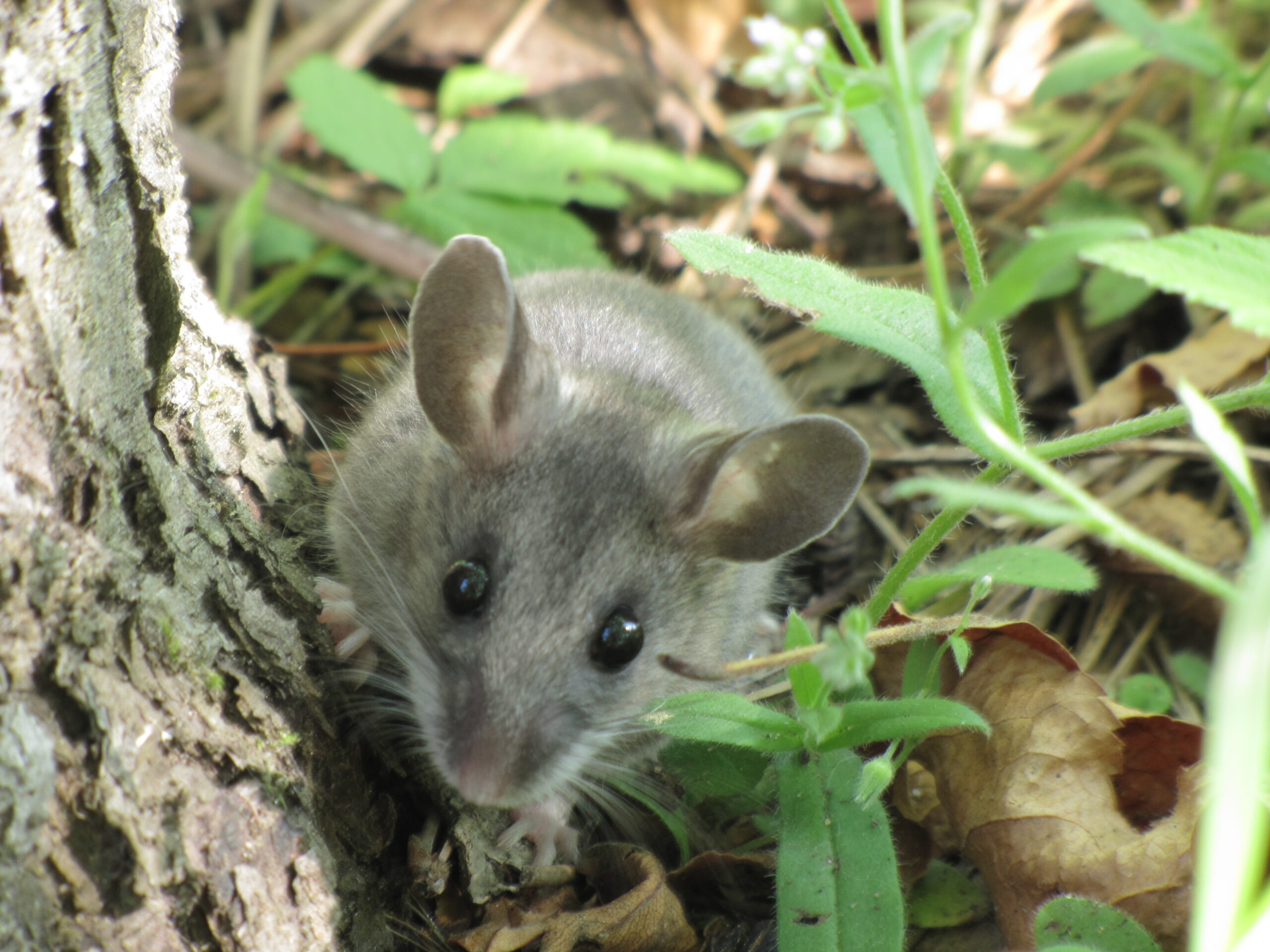
The deer mouse is one of the most distinctive small rodents in North America once you know the key features. Misidentification with house mice is common but correctable.
Size: Body 2.75 to 4 inches, tail roughly equal to body length. Slightly smaller overall than an adult house mouse, though the difference can be subtle.
Color: The most diagnostic feature. Deer mice have a sharp two-tone coloration — reddish-brown to grayish-brown on the back, sharply contrasted white on the belly, white feet, and white underside of the tail. The line between the darker back and white belly is distinct and clean. House mice are uniformly grayish-brown without sharp color contrast.
Tail: Bicolored — dark brown or grayish on top, white or pale underneath. This is the single most reliable field identification feature. House mouse tails are uniformly dark.
Eyes: Large, prominent, and dark — noticeably large relative to head size.
Ears: Large and rounded, prominent relative to head size.
Deer Mouse vs. House Mouse
Color: Deer mice have two-tone coloration with a clean break between brown back and white belly. House mice are uniformly gray-brown throughout.
Tail: Deer mouse tails are bicolored (dark on top, white below). House mouse tails are uniformly dark.
Eyes and ears: Deer mice have noticeably larger eyes and ears relative to body size.
Habitat: House mice are highly adapted to human structures and are year-round indoor pests in urban and suburban environments. Deer mice are edge-habitat animals — most common in outbuildings, rural structures, wooded suburban lots, and new construction areas rather than established urban housing.
Droppings: Both produce grain-of-rice sized droppings (approximately 1/4 inch with pointed ends). Deer mouse droppings are indistinguishable from house mouse droppings by size alone, which is why visual identification of the animal or nesting habits matters. If you find droppings in an outbuilding, shed, vacant structure, or attic of a rural-adjacent property, treat them as potentially from a deer mouse and follow hantavirus-safe cleanup protocols regardless.
Types Found in Oklahoma
[Diagram placeholder: Rodent identification comparison chart — Norway Rat vs. Roof Rat vs. House Mouse. Should show size, tail length, ear size, body shape, and dropping size at the same scale. Clean infographic on white background with labeled arrows. Pending artwork — replace at photo pass.]
Two Peromyscus species are found in Oklahoma:
Deer Mouse (Peromyscus maniculatus): The primary hantavirus carrier. The most widespread species in North America, found in Oklahoma statewide. Prefers open grassland, shrubland, and forest edge habitats but readily enters structures, especially at the rural-suburban edge. This is the species most commonly encountered in outbuildings, storage sheds, and rural homes.
White-footed Mouse (Peromyscus leucopus): Similar in appearance and habits to the deer mouse, also present in Oklahoma, particularly in wooded areas in the eastern part of the state. Can carry hantavirus but is less consistently associated with Sin Nombre hantavirus transmission than the deer mouse. Identification requires close examination — the two species are nearly identical in the field.
For treatment purposes, both species are managed identically. Both should be treated with hantavirus-safe protocols during cleanup.
Hantavirus: What Every Oklahoma Property Owner Needs to Know
This section covers the most important information on this page. Read it before anything else if you have found deer mouse activity in a closed space.
Hantavirus Pulmonary Syndrome (HPS) is a severe respiratory illness caused by Sin Nombre hantavirus. The CDC documents it as follows:
- Case fatality rate: approximately 36–40 percent. HPS is not a minor illness — it kills roughly one in three people who develop the full syndrome.
- Primary carrier in North America: the deer mouse (Peromyscus maniculatus).
- Transmission: inhalation of virus-contaminated dust. The virus is shed in deer mouse urine, feces, and saliva. When droppings or nesting material dry out in an enclosed space and are disturbed — swept, vacuumed without a mask, or disturbed during cleaning — virus particles become airborne. You do not need to be bitten or even touch a mouse.
- Oklahoma cases: Hantavirus cases have been documented in Oklahoma, primarily in rural and rural-adjacent settings. The OSDH tracks hantavirus as a reportable illness.
- High-risk situations: Opening a long-closed shed or outbuilding; cleaning a storage shed, barn, or attic with evidence of rodent activity; working in crawlspaces with rodent nesting material; handling stored items (camping gear, firewood, machinery) that have been in enclosed spaces where deer mice have been active.
Safe cleanup protocol (CDC guidelines summary):
- Air out the space for at least 30 minutes before entering. Open doors and windows and leave.
- Wear rubber or plastic gloves and an N95 or P100 respirator rated for biological particles. A standard dust mask is not sufficient.
- Wet down droppings, nesting material, and contaminated surfaces with a 10 percent bleach solution or EPA-registered disinfectant before handling. Do not dry sweep or vacuum.
- Place all contaminated material in sealed plastic bags. Double-bag.
- Wash gloved hands before removing gloves. Wash hands thoroughly after.
- Call or text Alpha Pest Solutions at (405) 977-0678 if the contamination is extensive — large-scale cleanup of deer mouse-infested attics or crawlspaces should not be DIY.
If you develop flu-like symptoms (fever, muscle aches, fatigue) within one to five weeks of a potential deer mouse exposure, seek medical attention immediately and inform the physician of the possible hantavirus exposure. Early-stage HPS is treatable with supportive care; late-stage cardiopulmonary failure progresses rapidly.
Diet, Behavior, and Habitat
Deer mice are omnivores with a strong preference for seeds and grain but will eat insects, berries, nuts, and fungi. A defining behavior is food caching — deer mice stockpile seeds and food in nest sites and in secondary caches throughout their range. Finding a cache of seeds in a drawer, wall void, or under equipment is a reliable sign of a deer mouse population.
Deer mice are primarily nocturnal and crepuscular. They are agile climbers and can access upper floors, attics, and rafters more easily than Norway rats. They can squeeze through openings approximately 1/4 inch in diameter — similar to house mice.
Home range is typically one to three acres, and deer mice do not travel long distances. A population in or near a structure is typically resident — the same animals returning nightly — rather than transient.
Deer mice do not hibernate, though they may slow down and reduce activity during extreme cold — spending more time in the nest and foraging less. In Oklahoma’s mild winters, activity continues year-round with reduced foraging range during the coldest periods. Structural entry increases in fall as temperatures drop.
Deer mice prefer natural cover — woodpiles, rock piles, brush piles, dense vegetation, and natural cavities — as primary harborage. When those habitats are adjacent to structures, deer mice readily move in. Outbuildings, barns, storage sheds, and detached garages are the highest-risk structures. Inside a home, attics, wall voids, and crawlspaces are preferred over finished living areas.
Life Cycle and Reproduction
Deer mice breed throughout the year in Oklahoma’s climate, with reduced activity in winter and peak breeding in spring and fall.
- Sexual maturity: 5 to 7 weeks
- Gestation: 21 to 27 days
- Litter size: 3 to 8 pups (average 4 to 5)
- Litters per year: 2 to 4 under field conditions; potentially more in protected indoor environments
- Pups weaned: approximately 25 days
- Population growth: a pair establishing in a protected indoor environment can produce 25 to 50 offspring in a year under good conditions
Nests are built from soft material — shredded insulation, fabric, plant fibers, and fur. Attic insulation is a primary nesting substrate. Nest sites in attics, wall voids, and the interiors of stored equipment concentrate the virus-laden droppings and urine that present the highest hantavirus exposure risk.
What Attracts Deer Mice to Oklahoma Properties
Rural and suburban-edge location: Deer mice are habitat generalists that move between natural areas and human structures. Properties at the edge of fields, creek corridors, wooded areas, and undeveloped land have persistent deer mouse pressure. This includes many of Oklahoma City’s suburban fringe communities — Edmond, Yukon, Mustang, and eastern Norman — where residential development meets open land.
New construction: Homes and structures in active construction areas are particularly attractive. Construction sites displace natural deer mouse populations, and the structures themselves — open during framing, often unoccupied during finishing phases, and surrounded by disturbed soil and debris — provide ideal harborage during and after the build. New construction in deer mouse territory should be inspected for rodent activity before first occupancy.
Outbuildings, barns, and storage structures: Deer mice strongly prefer structures with low human traffic. Barns, sheds, detached garages, and outbuildings with stored equipment, hay, seed, or grain are high-risk sites regardless of proximity to the main residence.
Stored food and seed: Pet food, birdseed, grass seed, deer corn, and livestock feed stored in garages, sheds, or outbuildings are primary attractants. Deer mice can enter containers not specifically designed to be rodent-proof.
Structural gaps and natural cover adjacent to the foundation: Wood piles, brush piles, and dense vegetation adjacent to a structure provide the natural cover deer mice prefer as approach habitat. Entry is through any gap 1/4 inch or larger.
Vacant or infrequently used structures: Sheds, seasonal outbuildings, and any structure that sits closed and unoccupied for extended periods accumulate deer mouse activity with no human disturbance to discourage it. Opening a vacant structure after weeks or months without inspection is one of the highest-risk hantavirus exposure scenarios.
Where Found in Oklahoma City Metro
Edmond and north Oklahoma City suburban fringe: Properties in northeast Edmond, along creek corridors, and in areas bordering undeveloped pasture or wooded land have consistent deer mouse pressure. Wooded lots and properties with natural drainage features are particularly attractive.
Yukon and Mustang: Western suburban areas with open land borders, active construction, and wooded creek corridors support deer mouse populations. Properties with acreage, horses, livestock, or agricultural outbuildings have higher risk.
Norman — eastern and rural edges: The eastern and southern edges of Norman, particularly properties adjacent to creek corridors, wooded parcels, or farm ground, have higher deer mouse activity than urban Norman. These same areas also see elevated wildlife pressure from raccoon, opossum, and armadillo — if the animal sounds heavy or is clearly larger than a mouse, see our Wildlife Control page.
Rural and semi-rural properties throughout the metro: Any Oklahoma City-area property with outbuildings, barns, storage sheds, or significant natural land cover adjacent to the structure has deer mouse risk. This includes acreage properties in Choctaw, Luther, Harrah, Tuttle, and Blanchard that fall within the broader service area.
Urban Oklahoma City (lower risk, not zero): Deer mice are less common in established urban neighborhoods than house mice or Norway rats, but are not absent. Properties adjacent to creek corridors, parks with natural habitat, and wooded areas in urban Oklahoma City can support deer mouse populations.
Where Found Inside Homes and on Properties
Attic: The single most common interior location for deer mice in residential structures. Deer mice access attics through roof vents, soffit gaps, gaps at utility penetrations, and openings at the roofline. Attic insulation is used extensively for nesting, concentrating droppings and urine in the insulation material itself.
Wall voids: Deer mice travel through wall voids between the attic and lower floors, nesting in insulated cavities.
Crawlspace: In crawlspace-foundation homes, deer mice establish beneath the floor and use the crawlspace as both harborage and transit. Vapor barrier and crawlspace insulation are frequently contaminated.
Outbuildings and detached garages: The highest-risk locations for deer mouse activity and hantavirus exposure. Low foot traffic, stored organic material, and connection to natural habitat make these ideal deer mouse environments.
Stored equipment and vehicles: Deer mice nest inside vehicle engine compartments, inside stored machinery, in toolboxes, and in any stored item with a cavity. Finding a seed cache in a car parked in a garage or barn is a reliable deer mouse indicator.
Kitchen and storage areas: In rural structures, deer mice will access pantry areas and stored grain, though they are less associated with kitchen areas of actively occupied homes than house mice.
Signs of a Deer Mouse Infestation
Droppings: Grain-of-rice sized (approximately 1/4 inch), rod-shaped with pointed ends, dark brown to black when fresh. Indistinguishable in size from house mouse droppings. Found along walls, in drawers, in stored items, and in nesting areas. Treat all small rodent droppings in outbuildings, attics, and rural structures as potentially from a deer mouse and follow safe handling protocols.
Nesting material: Soft, shredded nests built from insulation, fabric, plant material, and fur in enclosed spaces — inside stored equipment, in wall voids, in attic insulation, behind stored items in sheds.
Seed caches: Stockpiles of seeds, nuts, or grain in drawers, wall voids, under equipment, or in any enclosed cavity. This is a strongly diagnostic behavior — house mice do not cache food the way deer mice do.
Gnaw marks: Small gnaw marks on food packaging, stored seed containers, and structural materials. Similar in scale to house mouse gnaw damage.
Tracks: In dusty surfaces, hind footprints 0.5 to 0.75 inch long with four visible toes. Similar to house mouse tracks.
Odor: A musky rodent odor in enclosed spaces. Strong odor in a closed outbuilding, attic, or shed suggests significant accumulated urine and nesting material.
Visual sightings: Deer mice are primarily nocturnal but may be seen in low-light conditions. The distinctive two-tone coloration and large eyes are identifiable at a quick look.
What Does a Deer Mouse Sound Like?
Deer mice produce sounds similar to house mice — light, rapid, and higher-pitched than rat sounds.
Light pattering: Quick, light running sounds in attic spaces, wall voids, and above ceilings. The movement pattern is faster and lighter than Norway rat movement.
Scratching: Gnawing and nesting activity produces scratching sounds from within walls, attic insulation, or enclosed storage spaces.
Distinguishing from house mice: In practice, deer mouse and house mouse sounds are nearly indistinguishable by ear alone. Habitat and location are better differentiators — deer mice are more likely to be active in attics, outbuildings, and upper wall voids; house mice more commonly in kitchen and living areas.
Distinguishing from rats: Deer mouse sounds are dramatically lighter than Norway rat sounds. If the sound seems too light and rapid to be a rat, that is correct.
Think it might be something larger? If sounds are heavy, involve significant thumping, or seem to originate from a large animal moving through the attic space, visit our Wildlife Control page. Squirrels, raccoons, and opossums are common attic wildlife in Oklahoma City and sound substantially heavier than any mouse species.
How to Tell If the Infestation Is Active
Dropping freshness: Fresh droppings are dark, moist-looking, and soft. Old droppings are pale gray, dry, and crumble easily. Fresh droppings in a structure confirm current activity. Do not touch droppings with bare hands — use gloves and follow hantavirus-safe protocols.
Seed cache freshness: A recently stocked seed cache (seeds not yet dried out, no dust accumulation) indicates active use.
Glue board monitoring: Place glue boards along suspected runways in the attic, along walls in outbuildings, and near entry points. A catch within 48 hours confirms active population. Glue boards also confirm species — the deer mouse’s two-tone coloration is obvious on a glue board.
Tracking powder: Spread rodent-tracking powder or flour across suspected entry points and runways. Check after 24 hours for small mouse-sized prints.
Deer Mouse Season in Oklahoma
September through November (peak entry): As temperatures drop, deer mice move from outdoor harborage toward structural warmth. Oklahoma’s fall cooling triggers the primary entry wave. Properties with outbuildings, wooded borders, and attic access points are at highest risk.
December through February (winter): Interior populations are active but less mobile. Breeding continues at a reduced rate in protected spaces. Contamination accumulates in nesting areas with little disturbance if the structure is not in regular use.
March through May (spring dispersal): Deer mice begin moving outward again as temperatures warm. New populations establish in outdoor harborage. Spring is a common time to discover winter accumulations when a shed or outbuilding is opened for the first time after winter closure. This is one of the highest-risk hantavirus exposure scenarios — opening a sealed structure after months of deer mouse occupation without ventilating and following safe protocols first.
June through August (summer): Outdoor populations are active and reproducing. Entry into structures continues but at lower rates than fall. New construction in summer months, with structures left open, is a significant deer mouse entry window.
Health Risks
Hantavirus Pulmonary Syndrome (HPS)
This is the primary reason deer mouse activity requires immediate and careful attention. Sin Nombre hantavirus, carried by deer mice, causes HPS — a severe respiratory illness documented across North America.
The CDC and OSDH document the following:
- Transmission: Inhalation of dust contaminated with deer mouse urine, feces, or saliva. Bite transmission is possible but rare. No person-to-person transmission has been documented for Sin Nombre hantavirus.
- Incubation: 1 to 5 weeks after exposure.
- Symptoms (early): Fever, muscle aches, fatigue — indistinguishable from flu in the initial phase.
- Symptoms (late): Rapid onset of respiratory distress, fluid in the lungs, and cardiovascular compromise. HPS progresses quickly once it enters the cardiopulmonary phase.
- Treatment: No specific antiviral treatment. Supportive care in an ICU, including mechanical ventilation, is required for severe cases.
- Case fatality rate: approximately 36–40 percent.
- Oklahoma: Hantavirus cases have been documented in Oklahoma. The OSDH tracks HPS as a reportable disease.
The risk is real and the consequence is serious. Do not enter a deer mouse-contaminated space without proper respiratory protection and do not disturb dried droppings or nesting material without first wetting them down with disinfectant.
Other Health Concerns
Salmonellosis: Deer mice contaminate food surfaces and stored food with droppings and urine, with the same salmonella transmission pathway as other rodents.
Lyme disease tick vector: Deer mice are a primary reservoir host for Borrelia burgdorferi, the bacteria that causes Lyme disease, in areas where the black-legged tick is present. Oklahoma is at the western edge of established Lyme-carrying tick range, but tick-borne illness risk from deer mouse exposure is worth noting in eastern Oklahoma counties.
Allergens: Deer mouse dander, urine, and feces in attic insulation or crawlspace can circulate through ductwork and contribute to indoor allergen load.
Property Damage
Deer mice, like all rodents, have incisors that grow continuously at roughly 1 to 2 millimeters per week. Gnawing is a biological necessity — deer mice must chew on hard materials throughout their lives to prevent incisor overgrowth. This makes structural damage predictable wherever deer mice are nesting.
Insulation destruction: Nesting in attic insulation shreds and compacts it, reducing R-value and creating contaminated zones that require remediation rather than simple cleaning.
Wiring: Deer mice gnaw wire insulation in wall voids and attics. The NFPA estimates rodents are responsible for 20 to 25 percent of fires of undetermined origin in the United States. Deer mice contribute to this risk alongside rats and house mice.
Food stores: Deer mice contaminate and consume stored grain, seed, pet food, and livestock feed, and will gnaw through soft packaging to access it.
Stored equipment: Nesting inside vehicles, machinery, and equipment parked in outbuildings causes damage to wiring, insulation, air filters, and upholstery.
Structural materials: Gnaw damage to wood framing, vapor barrier, and HVAC ductwork in crawlspaces and attics is consistent with a well-established population.
Prevention
Deer mice exploit the same structural gaps as house mice — any opening 1/4 inch or larger is a potential entry point.
- Seal all foundation and roofline penetrations. Every pipe, conduit, and cable entering through the foundation, sill plate, soffit, or roof penetration must be sealed. Steel wool packed tightly and covered with metal plate or caulk is required — deer mice can chew through foam alone.
- Inspect and repair all roof vents, soffit vents, and ridge vents. Hardware cloth screening of 1/4 inch or smaller must cover all vents. Deer mice enter attics primarily through unscreened or damaged roof and soffit vents.
- Install door sweeps on all exterior doors including outbuilding and garage doors. A gap at the base of a door is one of the most common deer mouse entry points.
- Remove natural cover adjacent to structures. Wood piles, brush piles, rock piles, and dense ground cover within 10 feet of the foundation provide the approach cover deer mice use before entering.
- Store pet food, birdseed, and grain in sealed, rodent-proof containers. Hard-sided containers with tight-fitting lids — not bags or cardboard boxes — are required.
- Reduce attic and crawlspace access points. Ensure attic access panels fit tightly. Crawlspace vents should have intact, small-mesh screening.
- Maintain regular activity in outbuildings. Deer mice strongly prefer undisturbed spaces. Regular use of a barn, shed, or garage reduces deer mouse harborage suitability significantly.
- Inspect new construction before occupancy. Any home, outbuilding, or structure that has been framed and left open or vacant in deer mouse territory should be inspected for rodent activity before first use.
- Exterior bait station program. Tamper-resistant exterior bait stations along the foundation perimeter and near outbuilding walls intercept deer mice before they establish indoors. Ongoing service is the most effective long-term protection for rural-adjacent properties with persistent field pressure.
Not sure where gaps are or what exclusion work is needed? We assess entry points and structural vulnerabilities during every inspection and can perform exclusion or proofing work if needed. Call or text Alpha Pest Solutions at (405) 977-0678 to schedule.
Not sure where to start? We can walk through prevention measures during your inspection and perform any exclusion or proofing work needed. Contact Alpha Pest Solutions at (405) 977-0678 for a free inspection.
Control Process
Step 1: Inspection. A thorough inspection of the exterior perimeter, attic, crawlspace, and outbuildings identifies active runways, nesting sites, entry points, and the species present. For properties with known or suspected deer mouse activity, we treat the inspection as a health evaluation as well as a pest assessment. Inspections are free.
Step 2: Assessment. We determine whether the population is primarily indoor, outdoor, or in outbuildings, and assess the scope of any hantavirus-risk cleanup needed.
Step 3: Baiting. For most deer mouse situations, tamper-resistant bait stations are the most effective and efficient control method. Stations are placed along active runways in the attic, crawlspace, garage, and along exterior foundation walls. Bait is placed inside locked stations — not in open areas. Exterior stations along the foundation intercept field populations before they attempt entry.
Step 4: Trapping (when appropriate). Snap traps placed in the attic, outbuilding, or along active interior runways can be effective for localized populations. Deer mice accept trap bait more readily than Norway rats. Trapping is particularly appropriate in occupied living areas where bait station placement is not preferred.
Step 5: Exclusion (if desired). We can seal identified entry points with appropriate materials to prevent re-entry. Exclusion is especially important for attics and outbuildings with persistent field pressure.
Step 6: Remediation assessment. If deer mouse activity has resulted in contaminated attic insulation, crawlspace vapor barrier, or significant droppings accumulation, we can evaluate the scope of cleanup needed. See the Attic Remediation page for details. Contaminated insulation is a hantavirus exposure risk and should be assessed by Alpha Pest Solutions, not DIY-cleaned without proper protection.
Step 7: Ongoing exterior program. Properties adjacent to open fields, wooded areas, or creek corridors have persistent deer mouse pressure that does not end after a single treatment. An ongoing exterior bait station program serviced on a regular schedule is the most effective long-term management tool.
Control Timeline and Expectations
Days 1–7: Bait and traps placed. Deer mice are typically less neophobic than Norway rats and begin accepting bait within 24 to 48 hours. Initial reduction in activity should be noticeable within a week.
Days 7–14: For contained interior infestations, activity should approach zero. Attic or crawlspace populations may take slightly longer depending on population size.
Days 14–21: Properties with active field populations adjacent to the structure may see continued pressure from exterior deer mice. Exterior bait stations address this ongoing source.
Ongoing: On properties adjacent to open land, deer mice will re-establish if the exterior population is not actively managed. A recurring exterior bait station program and sealed entry points are both required for long-term protection.
What you may still notice after treatment:
- Old droppings in the attic or outbuilding are historical and not evidence of ongoing activity — they remain until cleaned
- Old nesting material in the attic or wall voids does not disappear on its own — remediation removes it
- Any remaining seed caches are historical and should be removed during cleanup
Frequently Asked Questions
How do I know if I have deer mice or house mice?
The most reliable visual identifier is color: deer mice have a sharply defined two-tone pattern — brown or reddish-brown back with a white belly and white feet. House mice are uniformly gray-brown without a distinct color break. The tail is also diagnostic: deer mouse tails are bicolored (dark on top, white below); house mouse tails are uniformly dark. Both species produce grain-of-rice sized droppings that are not distinguishable by size alone. Location also helps — deer mice are far more common in outbuildings, attics of rural-adjacent homes, and new construction than in kitchen areas of established urban homes.
Is a deer mouse dangerous?
Yes — significantly more so than house mice from a disease standpoint. The deer mouse is the primary reservoir for Sin Nombre hantavirus, which causes Hantavirus Pulmonary Syndrome (HPS). The CDC documents HPS with a case fatality rate of approximately 36 to 40 percent. Transmission occurs through inhaling dust from dried deer mouse droppings, urine, or nesting material — not just through bites. Any confirmed or suspected deer mouse activity in an enclosed space should be approached with respiratory protection and proper disinfection protocol.
Can I clean up deer mouse droppings myself?
For a small amount of fresh droppings in a well-ventilated space, careful DIY cleanup following CDC guidelines — rubber gloves, N95 or better respirator, wet down droppings with 10% bleach solution before handling, double-bag waste, do not dry sweep or vacuum — is manageable. For large accumulations in attics, crawlspaces, or outbuildings; dried or extensive nesting material; or any situation where you are uncertain about the scope, call or text Alpha Pest Solutions at (405) 977-0678 — we can assess the scope and handle remediation safely. The hantavirus risk from improper cleanup of a heavily contaminated attic or crawlspace is serious. See our Attic Remediation page.
I found deer mouse droppings in my shed after it was closed all winter. What do I do?
This is one of the highest-risk hantavirus exposure scenarios. Do not enter the shed and start cleaning immediately. First, open windows and doors and ventilate the space for at least 30 minutes before re-entering. Wear an N95 or better respirator and rubber gloves. Wet down all droppings and nesting material with a 10% bleach solution before touching or moving anything. If the accumulation is extensive — significant nesting in the walls or on surfaces, heavy droppings throughout — contact Alpha Pest Solutions rather than attempting large-scale cleanup without proper equipment.
Is rodent baiting safe with pets and children?
Yes, when conducted correctly. All bait is placed inside tamper-resistant, locked stations that children and pets cannot open without tools. Stations are positioned in attics, along crawlspace perimeters, and at foundation wall locations — not in areas accessible during normal daily activity. We do not place open bait in exposed areas when children or pets are present. If you ever suspect a pet or child has contacted rodent bait, call ASPCA Animal Poison Control at (888) 426-4435 or Poison Control at (800) 222-1222 immediately. We can provide full product information at the time of service.
Can my dog or cat get hantavirus from catching a deer mouse?
Current research does not establish dogs and cats as susceptible to Sin Nombre hantavirus infection, and there are no documented cases of pets transmitting hantavirus to humans through this route. However, a pet that hunts deer mice in an outbuilding or field can carry contaminated material on its coat, and a bitten or scratched mouse can leave urine on surfaces where contact occurs. Keep this in mind when handling pets that have been active in deer mouse habitat.
Is secondary poisoning from rodent bait a risk to my pets or to raptors?
Secondary poisoning — a pet, hawk, or owl being harmed by consuming a rodent that ate bait — is a real concern that deserves a direct answer. The risk exists but is substantially mitigated by how the bait is placed. Modern rodenticides used in our programs are dosed for rodent physiology and placed inside tamper-resistant, locked stations away from open foraging areas. A pet or raptor would need to consume a significant number of bait-exposed rodents to approach a harmful dose through secondary exposure — the primary risk is always direct bait access, which locked stations prevent. The EPA and NPMA both note that proper placement practices are the most effective tool for minimizing non-target exposure. We do not place open bait in accessible locations. If you have working dogs, outdoor cats, or nesting raptors on your property, mention this at the time of inspection and we will factor it into our placement approach.
What is the difference between a deer mouse and a white-footed mouse?
The two species are nearly identical in the field. Both have the characteristic two-tone coloration, large eyes, and similar size. White-footed mice tend to be slightly larger with a redder tone, but this is not reliably distinguishable without close examination. For treatment purposes the distinction does not matter — both are managed the same way and both should be treated with hantavirus-safe protocols during cleanup.
How did deer mice get into my attic?
The most common attic entry points are unscreened or damaged roof vents, soffit vents, ridge vents, and gaps around pipe or conduit penetrations through the roof deck or soffit. Deer mice are agile climbers and can scale exterior walls and travel along utility lines to reach roofline entry points. A gap of 1/4 inch is sufficient for entry. An inspection identifies all active entry points and can guide exclusion work.
Will deer mice come back after treatment?
On properties adjacent to open fields, wooded areas, or creek corridors, yes — if the exterior population is not actively managed and entry points are not sealed. Deer mice do not travel long distances, but a field population 50 to 100 feet from the structure will continuously attempt entry unless intercepted. An ongoing exterior bait station program and sealed entry points together are the most reliable long-term protection.
Do deer mice carry diseases other than hantavirus?
Yes. Deer mice are a reservoir host for the bacteria that causes Lyme disease (Borrelia burgdorferi) in areas where the black-legged tick is established. They can also carry salmonella, which contaminates food surfaces and stored food through droppings and urine. Hantavirus is by far the most serious health concern associated with deer mice in Oklahoma, but it is not their only disease risk.
I found a seed cache in my garage. Is that a deer mouse?
Almost certainly. Food caching — stockpiling seeds in a hidden location — is a strongly characteristic deer mouse behavior. House mice do not cache food this way. Finding a neat pile of seeds, nuts, or grain in a drawer, wall void, under equipment, or in a corner of a garage or shed is one of the most reliable indicators of a deer mouse (or white-footed mouse) population. Treat the space accordingly.
My property is new construction — are deer mice a risk?
Yes, and the risk is elevated during and immediately after construction. Structures in active construction areas are left open during framing, often vacant for weeks or months during the finishing phase, and are surrounded by disturbed soil and displaced wildlife habitat. Deer mice readily move into partially built or unoccupied structures. New construction in fields, wooded areas, or on lots adjacent to natural land cover should be inspected for deer mouse activity before first occupancy and treated if found.
Related Services and Pests
- House Mouse
- Norway Rat
- Mouse vs. Rat Comparison
- Rodent Control Service
- Attic Remediation
- Wildlife and Rodent Proofing
- Wildlife Control
Get a Free Rodent Inspection in Oklahoma City
If you have found deer mouse droppings, nesting material, or seed caches in your attic, outbuilding, or crawlspace — or if you have any reason to suspect deer mouse activity in a structure on your property — call or text Alpha Pest Solutions at (405) 977-0678 for a free inspection. We take rodent activity in enclosed spaces seriously and treat each inspection as a health and pest assessment. We serve Oklahoma City, Edmond, Norman, Moore, Midwest City, Del City, Yukon, Mustang, and the surrounding Oklahoma City metro. Monday through Saturday, 7am to 7pm.