
Skunk
Scientific name: Mephitis mephitis (striped skunk) | Spilogale putorius (eastern spotted skunk)
Order: Carnivora
Family: Mephitidae

What Does a Skunk Look Like?
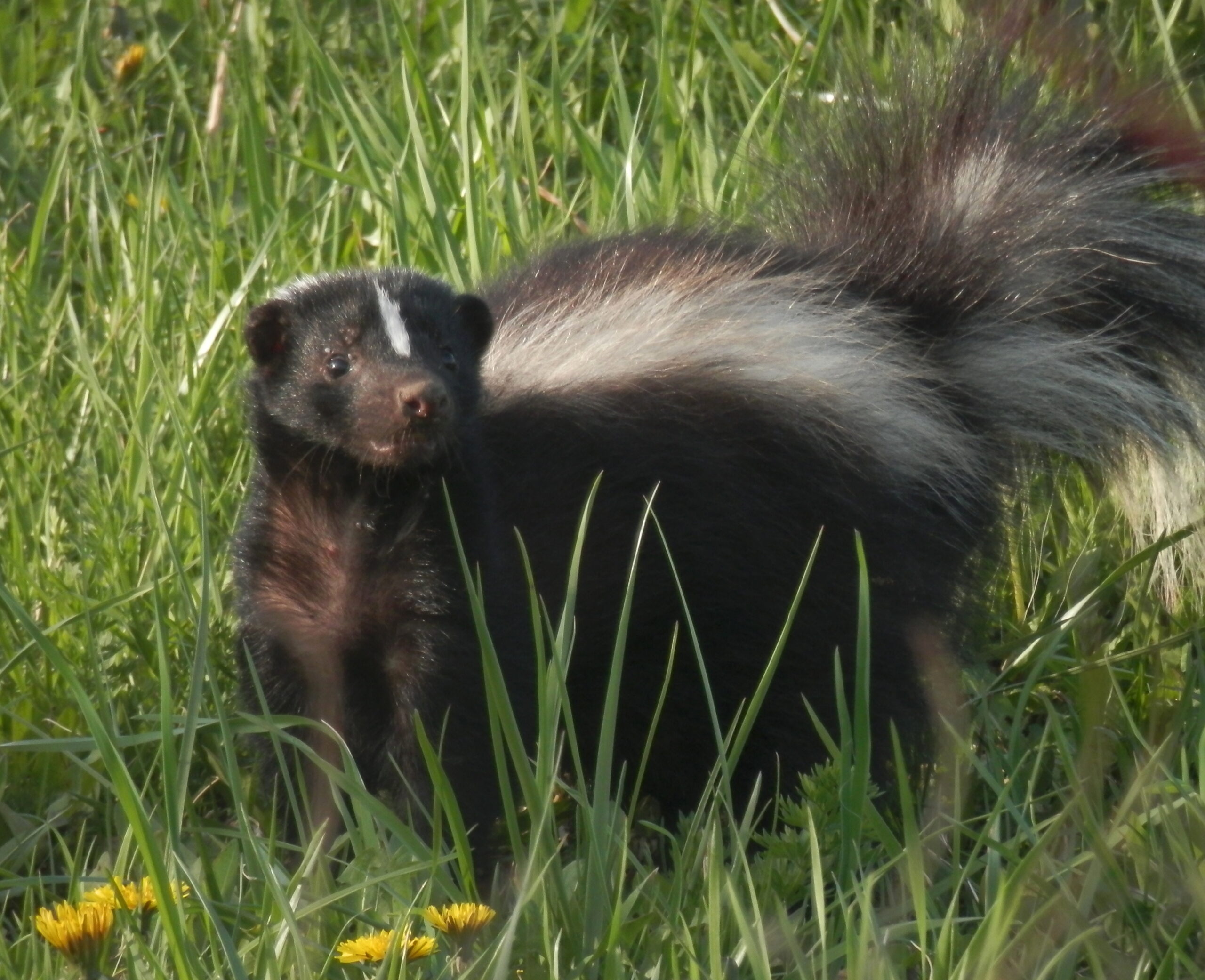
The striped skunk is the species most commonly encountered in the Oklahoma City metro. It is roughly the size of a house cat — 3 to 10 pounds, 20 to 30 inches long including the tail. The coat is glossy black with a white stripe that forks at the neck and runs down both sides of the back to the tail. The tail is large, bushy, and black with white tips or frosting. The face has a thin white stripe from nose to forehead. The front feet carry long, curved claws well-suited to digging.
The eastern spotted skunk is significantly smaller — 1 to 2 pounds — and has a broken, spotted-looking white pattern rather than solid stripes. It is far less common in the Oklahoma City metro but is occasionally encountered in rural or heavily wooded areas east of the city. It can handstand before spraying, which the striped skunk does not do.
Skunk vs. armadillo: If the animal was not directly sighted, skunk and armadillo activity in lawns can be confused — both dig in turf searching for grubs and insects. Armadillo burrows are typically more rounded, deeper, and larger than skunk digging. Armadillos also leave more extensive burrowing around foundations, under slabs, and along fence lines, while skunk digging tends to be shallower and scattered across the lawn surface. If you are seeing damage along a foundation or under a concrete edge, armadillo is more likely; if you’re seeing shallow scattered holes in the grass, skunk is the more likely culprit. See our Armadillo page.
Behavior and Biology
Nocturnal Activity
Skunks are primarily nocturnal. They forage after dark, which is why most encounters happen at dusk, dawn, or overnight. If you are seeing a skunk during daylight hours moving erratically, stumbling, or showing no fear of people, that is a significant rabies concern — keep people and pets away and call immediately.
Diet
Striped skunks are omnivores and opportunistic feeders. Their diet includes insects (grubs are a primary target), earthworms, small rodents, bird eggs, carrion, berries, and garden waste. The conical digging holes in lawns — about 1 to 3 inches across, shallow — are often the first visible sign of a skunk searching for grubs.
IMAGE: Conical grub-digging holes in a lawn, 1–3 inches wide. Caption: “Shallow conical digging in turf is a classic skunk foraging sign. Grubs under the soil surface are the primary target.”
Digging and Burrowing
Skunks are excellent diggers. In addition to lawn foraging, they will burrow under driveways, foundations, decks, fences, and concrete pads with relative ease. A skunk that decides to den under a slab or beside a foundation is working with purpose — the excavation can be significant and, over time, can undermine concrete edges and footings.
Home Range and Movement
Striped skunks typically range 1 to 3 miles per night but maintain a core territory closer to their den. In the Oklahoma City metro, they move along creek corridors, drainage channels, fence lines, and the edges between residential development and open fields. Home range varies by sex and season — males roam farther during breeding season (February through March).
Communal Winter Denning
Skunks do not hibernate, but they enter a state of winter torpor during cold stretches. During this period, multiple skunks — typically a male with several females — may den together in a single location. If you discover skunks under your deck or shed in January or February, there may be 3 to 5 animals present rather than one. This matters significantly for removal and exclusion planning.
Breeding and Litter Timing
Breeding occurs in February through March. Kits are born in May, with typical litters of 4 to 7. Young skunks are capable of spraying at roughly 3 weeks old, even before their eyes open. Kits remain with the mother through late summer.
Exclusion timing is critical: If you seal a den entrance in May, June, or July, there is a very high probability that kits are inside. Sealed-in animals will die, creating odor and structural problems. We assess litter status before any exclusion work begins during these months.
The Spray: How It Works and What to Do
Anatomy and Mechanism
Skunks carry two anal scent glands that produce a sulfur-containing chemical compound, primarily (E)-2-butene-1-thiol and 3-methyl-1-butanethiol. The glands hold enough material for 4 to 6 full sprays before depletion, which takes roughly 10 days to replenish. Skunks are reluctant to spray because of this — they typically give warning signs first: foot stomping, tail raising, arching the back, and short-range bluff charges. If a skunk is giving these signals, back away slowly and give it an exit route.
Spray Distance and Accuracy
A striped skunk can spray with accuracy at 10 to 12 feet and reach up to 20 feet with some accuracy loss at distance. Wind will carry the odor significantly farther. The spray is aimed at the face — specifically the eyes, which causes temporary burning and tearing. Skin contact is intense but does not cause lasting harm. Inhalation at close range causes nausea.
IMAGE: Skunk in spray-warning posture — tail raised, facing camera, front feet stamping. Caption: “A skunk in warning posture: tail raised, stamping feet. This is the animal’s signal that a spray is imminent. Back away slowly.”
Odor Neutralization: What Actually Works
Commercial skunk odor products vary significantly. The most widely validated home formula is:
- 1 quart 3% hydrogen peroxide
- ¼ cup baking soda
- 1 teaspoon liquid dish soap
Mix immediately before use — do not store in a sealed container (CO2 buildup). Apply to affected area, let sit 5 minutes, rinse. This oxidizes the thiol compounds and neutralizes them rather than masking them.
Tomato juice does not neutralize skunk spray. It temporarily overloads the olfactory sense (olfactory fatigue), making you temporarily less aware of the odor. The smell returns when the tomato juice dries.
For sprayed pets: use the hydrogen peroxide formula on the coat, avoid eyes. For sprayed clothing: washing with the formula before the cycle, or using an enzyme-based laundry additive, improves results. Heavily sprayed fabric may not fully recover.
For a building, vehicle, or enclosed space, odor remediation involves ventilation plus oxidizing agents or ozone treatment. This is not a one-wash fix for a heavily sprayed structure.
Health Risks
Rabies — Oklahoma’s Primary Vector
Skunks are the number one rabies vector species in Oklahoma. The Oklahoma State Department of Health and the CDC consistently identify skunks as the primary source of animal rabies in this state — more than raccoons, foxes, or bats in terms of confirmed positive cases in Oklahoma wildlife.
A skunk acting abnormally during daytime, showing no fear response, walking in circles, or appearing disoriented should be assumed rabid until confirmed otherwise. Do not approach, attempt to handle, or corner the animal. Contact your local animal control or Alpha Pest Solutions immediately.
If a person or pet is bitten by a skunk: Wash the wound thoroughly with soap and water for 15 minutes, seek medical care immediately, and report the exposure to Oklahoma County Health Department or your county health department. Post-exposure prophylaxis (PEP) is highly effective but time-sensitive.
Pets should be current on rabies vaccination. Vaccinated pets that are bitten by a suspected rabid animal still require a booster and observation period — contact your veterinarian.
Leptospirosis
Skunks carry and shed Leptospira bacteria in their urine. Leptospirosis is transmissible to dogs through contact with contaminated soil or water. In rymans, infection is possible through skin abrasions or mucous membrane exposure to contaminated urine or water. Serious illness can involve liver and kidney damage. Dogs in the Oklahoma City metro should be current on the leptospirosis vaccine, particularly in (outholds near creek corridors or areas with known wildlife activity.
Canine Distemper
Skunks are susceptible to and can transmit canine distemper. This is a serious concern for unvaccinated dogs. A skunk acting disoriented during daylight may be rabid, but canine distemper produces similar neurological symptoms. Either way, do not allow pets near such an animal.
Parasites
Skunks carry fleas, ticks, and intestinal parasites. Animals denning under structures can seed the surrounding area with fleas, which can then move into the yard and into the home.
Property Damage
Digging and Burrowing
Foraging for grubs produces the shallow conical holes in lawns described earlier — this is the most common visible evidence of skunk activity. But skunks will also burrow aggressively for denning purposes. We have seen skunks tunnel under driveways, foundations, deck piers, fences, and concrete slabs. This level of excavation can undermine footings and create structural issues in addition to the obvious odor and pest concerns.
Denning Under Structures
Skunks den under decks, porches, additions, sheds, outbuildings, and concrete stoops with accessible crawl space. Their presence under a structure:
- Creates persistent odor, particularly if the animal sprays near the den
- Introduces fleas and other parasites to the immediate area
- Creates a rabies risk for pets
- May attract other wildlife to the same den site
If a skunk has sprayed under or near your structure, the odor can infiltrate HVAC systems, crawlspaces, and living areas. Remediation requires addressing both the animal and the odor source.
Garden Damage
Skunks occasionally raid vegetable gardens and fruit that has fallen to the ground, but they are not thevel”:3} –>
Nocturnal Activity
Skunks are primarily nocturnal. They forage after dark, which is why most encounters happen at dusk, dawn, or overnight. If you are seeing a skunk during daylight hours moving erratically, stumbling, or showing no fear of people, that is a significant rabies concern — keep people and pets away and call immediately.
Diet
Striped skunks are omnivores and opportunistic feeders. Their diet includes insects (grubs are a primary target), earthworms, small rodents, bird eggs, carrion, berries, and garden waste. The conical digging holes in lawns — about 1 to 3 inches across, shallow — are often the first visible sign of a skunk searching for grubs.
IMAGE: Conical grub-digging holes in a lawn, 1–3 inches wide. Caption: “Shallow conical digging in turf is a classic skunk foraging sign. Grubs under the soil surface are the primary target.”
Digging and Burrowing
Skunks are excellent diggers. In addition to lawn foraging, they will burrow under driveways, foundations, decks, fences, and concrete pads with relative ease. A skunk that decides to den under a slab or beside a foundation is working with purpose — the excavation can be significant and, over time, can undermine concrete edges and footings.
Home Range and Movement
Striped skunks typically range 1 to 3 miles per night but maintain a core territory closer to their den. In the Oklahoma City metro, they move along creek corridors, drainage channels, fence lines, and the edges between residential development and open fields. Home range varies by sex and season — males roam farther during breeding season (February through March).
Communal Winter Denning
Skunks do not hibernate, but they enter a state of winter torpor during cold stretches. During this period, multiple skunks — typically a male with several females — may den together in a single location. If you discover skunks under your deck or shed in January or February, there may be 3 to 5 animals present rather than one. This matters significantly for removal and exclusion planning.
Breeding and Litter Timing
Breeding occurs in February through March. Kits are born in May, with typical litters of 4 to 7. Young skunks are capable of spraying at roughly 3 weeks old, even before their eyes open. Kits remain with the mother through late summer.
Exclusion timing is critical: If you seal a den entrance in May, June, or July, there is a very high probability that kits are inside. Sealed-in animals will die, creating odor and structural problems. We assess litter status before any exclusion work begins during these months.
primary garden pest they are sometimes assumed to be. Most garden “skunk damage” is actually raccoon or rabbit damage. The presence of grub-digging holes in the lawn is the more reliable skunk indicator.Where Skunks Are Found in Oklahoma City
Skunks are common throughout the Oklahoma City metro. Highest-density areas:
Creek corridors and greenways: The Canadian River, North Canadian (Oklahoma River), Arcadia Lake area, and virtually every creek drainage through Edmond, Oklahoma City, and Norman has resident skunk populations. Properties adjacent to or backing up to these corridors experience the most activity.
Norman: Norman is a high-activity area for skunks, particularly in neighborhoods along creek drainages and the wooded residential areas in eastern Norman. If you’re in Norman and have a skunk situation, we handle it.
Suburban edges: Yukon, Mustang, Choctaw, Harrah, Blanchard — any area where residential development meets agricultural land or undeveloped grassland — has significant skunk pressure. These transition zones are ideal skunk habitat.
Established urban Oklahoma City: Skunks move through established neighborhoods regularly, particularly in areas with older landscaping, mature trees, and low-clearance decks or porches. Midtown, Nichols Hills, Edmond’s older established sections all see consistent activity.
Rural properties: Grain storage, barns, livestock operations, and outbuildings throughout the metro area attract skunks year-round due to food and shelter availability.
Prevention and Exclusion
The most effective way to keep skunks from denning under your structure is professional exclusion. We install barrier systems at deck and porch foundations, along fence lines with adjacent crawl access, and at any ground-level gap that provides skunk den access. These systems account for the fact that skunks are capable burrowers — a barrier that only goes straight down can be dug under. Our methods are designed to stop a determined digging animal.
We can perform preventative exclusion before you have a problem — many homeowners in high-activity areas have us install barriers proactively. This is far less expensive and stressful than dealing with a denning skunk or a spray event afterward.
Addressing food sources is also effective: pet food left outside overnight, unsecured garbage, fallen fruit, and birdseed on the ground at night all attract skunks reliably. Grub treatment for heavily infested lawns removes the primary food source driving skunk activity in the turf.
If you are considering handling a skunk situation yourself — including DIY trapping — we strongly recommend calling us instead. Handling a skunk without the right equipment and experience significantly increases the chance of a spray event, which means cost, odor remediation, and potential exposure of pets and family members. We use professional-grade equipment and methods that reduce that risk substantially.
How Alpha Pest Solutions Handles Skunks
IMAGE: Technician in PPE examining a low-clearance deck for skunk activity, with a flashlight and inspection mirror. Caption: “A thorough inspection identifies active entry points, confirms skunk presence, and checks for kits before any work begins.”
- Inspection. We identify the den location, assess the number of animals (especially important in winter communal denning), and check for the presence of kits. We also assess the structural situation and determine the right approach — trapping, exclusion, or a combination — based on what we find.
- Litter assessment. If the timeline falls in May through August, we assess for kits before sealing anything. A sealed entry with live kits inside creates more problems than it solves.
- Trapping or exclusion. The right approach depends on the circumstances. Both options are available to us. Skunks in traps must be handled carefully — our technicians know the warning signs and use covered traps and calm, deliberate movement to minimize spray risk.
- Removal. Skunks are handled and transported in accordance with Oklahoma Department of Wildlife Conservation guidelines.
- Exclusion installation. After confirmed removal of all animals, entry points are sealed and barrier systems installed to prevent return. If there was odor contamination under the structure, we address that as part of the service.
- Follow-up. Confirmation that the exclusion is holding and no re-entry has occurred.
When to Call Alpha Pest Solutions
Call or text (405) 977-0678 if:
- You have skunks denning under a deck, porch, shed, or other structure
- You have been sprayed or your pet has been sprayed near your property
- You have persistent skunk odor in or under your home
- You are seeing a skunk during daylight hours acting erratically (call immediately — potential rabies)
- You want preventative exclusion installed before a problem develops
We serve Oklahoma City, Edmond, Norman, Moore, Midwest City, Del City, Yukon, Mustang, and the surrounding Oklahoma City metro. Monday through Saturday, 7am to 7pm.
Frequently Asked Questions
Will a skunk spray inside a trap?
Yes, they can. The risk is reduced significantly by covering the trap with a tarp or heavy cloth immediately after the animal enters — removing the visual stimulus reduces the threat response. Slow, deliberate movement around a trapped skunk also reduces spray risk. Our technicians are trained in this; it is not something we recommend homeowners attempt.
Can I spray ammonia or mothballs to repel skunks?
These are frequently recommended home remedies. The reality is that their effectiveness is temporary at best, and mothballs (naphthalene) are a registered pesticide — placing them in crawlspaces or under decks in ways not consistent with label direction is a federal violation. They also pose a health risk to children and pets. Exclusion is the only reliable long-term solution.
What about skunk repellent sprays, predator urine, or cayenne pepper?
These products are sold widely and have limited evidence supporting their effectiveness for skunks. They may create brief aversion but do not hold up against a motivated animal with an established den. Do not rely on these as a primary deterrent.
A skunk got into my crawlspace. Can I just wait for it to leave?
Skunks establish dens and return to them. If it found entry, it will return, and if conditions are favorable, it will den. Waiting is not a reliable strategy.
Is it legal to trap skunks in Oklahoma?
Striped skunks are unprotected furbearing animals in Oklahoma and can be taken by licensed nuisance wildlife control operators (NWCOs). Alpha Pest Solutions holds the appropriate licensing. Given the rabies risk, DIY trapping of skunks is not recommended. Let us handle it.
My dog got sprayed. What do I do?
Get the dog away from the skunk immediately. Apply the hydrogen peroxide/baking soda/dish soap formula to the affected areas of the coat, avoiding the eyes — if the dog was sprayed in the face, use plain water to flush the eyes. Treat with the formula for 5 minutes, then rinse. You may need to repeat. Call your vet if the dog was bitten in addition to sprayed. Check that your dog’s rabies vaccination is current and report any bite exposure.
Related Library Pages and Services
Rabies vector data sourced from Oklahoma State Department of Health and CDC. Leptospirosis information from CDC and AVMA. Skunk biology from OSU Extension and Oklahoma Department of Wildlife Conservation guidelines.