
Quick Reference: Mouse vs. Rat
[Diagram placeholder: Rodent identification comparison chart — Norway Rat vs. Roof Rat vs. House Mouse. Should show size, tail length, ear size, body shape, and dropping size at the same scale. Clean infographic on white background with labeled arrows. Pending artwork — replace at photo pass.]
| Feature | House Mouse | Deer Mouse | Norway Rat | Roof Rat |
|---|---|---|---|---|
| Body length | 2.5–3.75 in | 2.75–4 in | 7–9.5 in | 6–8 in |
| Weight | 0.5–1 oz | 0.5–1.2 oz | 7–18 oz | 5–9 oz |
| Dropping size | ~1/4 in, pointed ends | ~1/4 in, pointed ends | ~3/4 in, blunt ends | ~1/2 in, curved pointed ends |
| Entry gap needed | 1/4 in | 1/4 in | 3/4–1 in | 1/2 in |
| Tail | Uniformly dark, hairless | Bicolored (dark top, white below) | Shorter than body, thick | Longer than body, thin |
| Ears | Large relative to body | Very large relative to body | Small relative to body | Prominent, naked |
| Color | Uniformly gray-brown | Two-tone: brown back, white belly | Brown/gray, pale underside | Dark gray to black above, lighter below |
| Common in Oklahoma City | Very common — urban, suburban, statewide | Rural-adjacent, outbuildings, suburban edge | Very common — older urban Oklahoma City, established neighborhoods | Rare in Oklahoma City |
| Primary health concern | Salmonellosis, allergens | Hantavirus (HPS) — 36–40% fatality rate | Leptospirosis, salmonellosis | Leptospirosis, salmonellosis |
| Behavior toward new objects | Curious — investigates within hours | Curious — investigates within hours | Neophobic — avoids new objects 24–72 hrs | Moderately neophobic |
| Water needs | Gets most water from food | Gets most water from food | Requires ~1 oz water/day | Requires water source |
| Home range | 10–20 ft from nest | 1–3 acres | ~100 ft from nest | 100–300 ft |
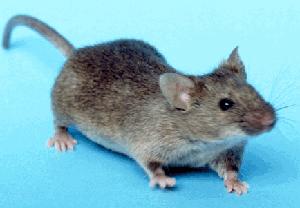
Oklahoma City has four rodent species that matter for pest control purposes: the house mouse, the deer mouse, the Norway rat, and the roof rat. Most Oklahoma City property owners dealing with a rodent problem have one of the first two — house mouse or Norway rat — but correctly identifying which one changes the treatment approach significantly. This page breaks down the differences in size, behavior, droppings, entry points, and health risk so you can identify what you are dealing with before calling.
If you have already identified the species and want control information, see the individual library pages: House Mouse, Deer Mouse, Norway Rat. Inspections are free — call or text Alpha Pest Solutions at (405) 977-0678.
Size: The Most Immediate Visual Difference
This is the fastest way to rule species in or out.
Mice (house mouse, deer mouse): Body 2.5 to 4 inches. Total length including tail roughly 5 to 8 inches. Think: small enough to fit in your palm with room to spare. Weight under 1.5 ounces.
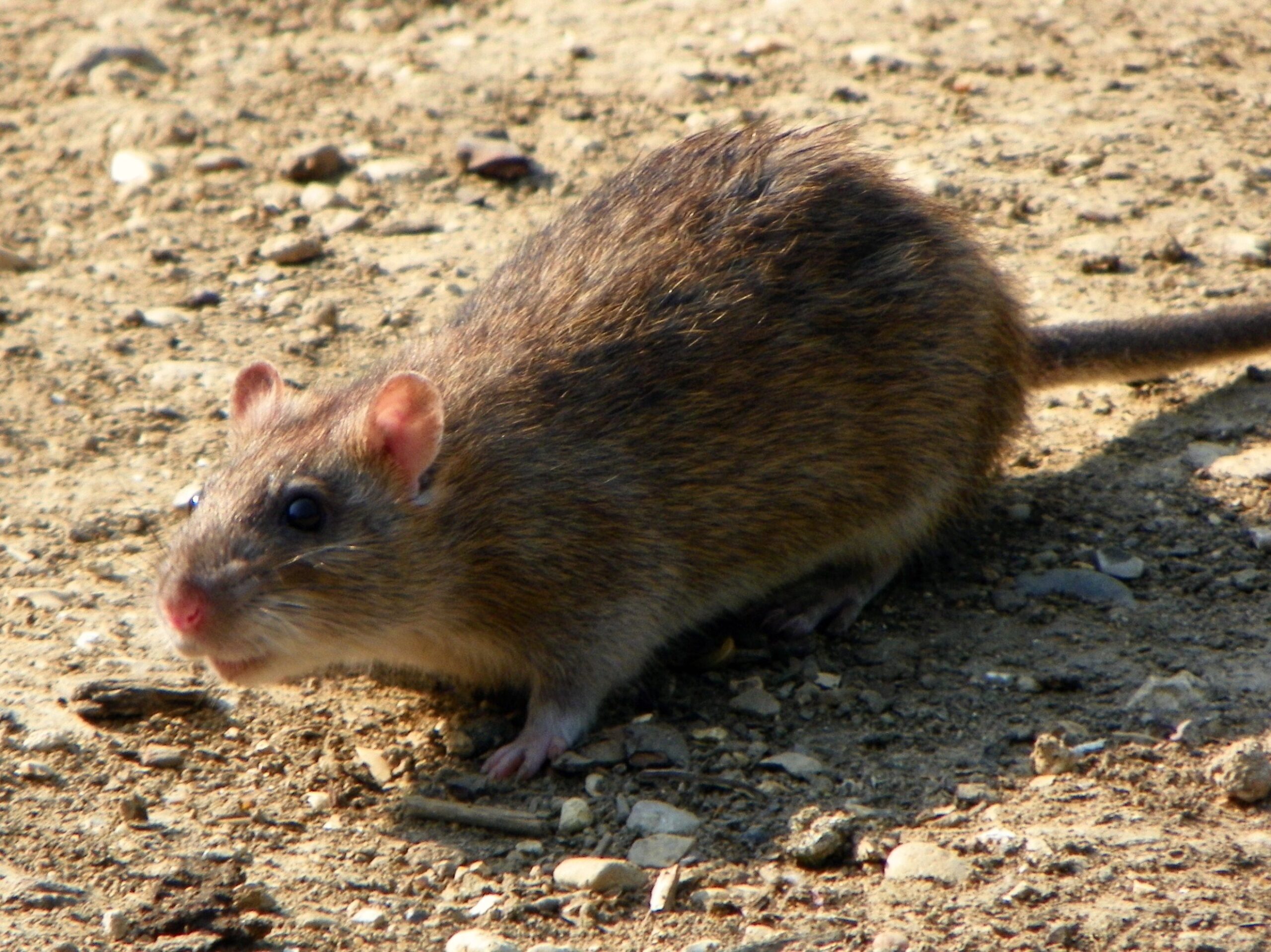
Rats (Norway rat, roof rat): Body 6 to 9.5 inches. Total length 12 to 18 inches. Weight 5 to 18 ounces — a Norway rat weighs as much as a small apple. If the animal looks large, heavy-bodied, and substantial, it is almost certainly a rat.
If there is any ambiguity about what you saw, it was probably a mouse. Adult Norway rats are distinctly large animals, and there is very little visual overlap between an adult rat and a mouse.
Droppings: The Most Common Evidence
Droppings are usually what people find first. Size, shape, and location together narrow the species down quickly.
[IMAGE: Dropping size comparison — mouse dropping, roof rat dropping, and Norway rat dropping side by side next to a penny for scale. Caption: “Mouse droppings (left) are 1/4 inch. Roof rat (center) are 1/2 inch. Norway rat (right) are 3/4 inch — roughly the size of a Tic Tac.”]
Mouse droppings (house mouse and deer mouse): Approximately 1/4 inch long. Rod-shaped with pointed ends at both tips. Often compared to a grain of rice. Dark brown to black when fresh, gray when old. Found scattered along walls, in drawers, in stored items, and in nesting areas. House mouse and deer mouse droppings are the same size and are not distinguishable from each other by appearance alone.
Norway rat droppings: Approximately 3/4 inch long — about the size of a Tic Tac. Blunt, rounded ends, capsule-shaped. Substantially larger than mouse droppings. Found along runways, near food sources, and in harborage areas. There is no ambiguity between mouse and Norway rat droppings once you see both — the size difference is dramatic.
Roof rat droppings: Approximately 1/2 inch long. The distinguishing shape difference from Norway rat droppings: roof rat droppings taper to a curved point at both ends — picture a small curved banana or a tiny curved sausage that comes to a tip rather than a rounded end. Norway rat droppings have blunt, flat-rounded ends like a capsule. Roof rat droppings fall in between mouse and Norway rat in size, which can cause confusion — but the curved, pointed-end shape is distinct from both.
Practical rule: If the droppings are grain-of-rice sized with pointed ends, you have mice. If they are Tic Tac sized with blunt ends, you have Norway rats. If the droppings are mid-sized (about 1/2 inch) and curved with pointed ends, roof rat — though roof rats are rare in Oklahoma City. If you are finding both small and large sizes in the same structure, you may have both species.
Important note on deer mice: If you find small (mouse-sized) droppings in an outbuilding, barn, storage shed, or attic of a rural-adjacent property, treat them as potentially from a deer mouse and follow hantavirus-safe cleanup protocols regardless of whether you have confirmed the species. Deer mouse and house mouse droppings are identical in size. The health risk from deer mouse droppings — Sin Nombre hantavirus — is serious enough that erring on the side of caution is the right call.
Physical Identification: What to Look For
House Mouse
- Uniformly gray-brown coat, no color break between back and belly
- Large ears relative to body size
- Uniformly dark, hairless tail — same color throughout
- Small, pointed muzzle
- Eyes moderate-sized
- Most common in kitchen areas, behind appliances, in walls, in living spaces
Deer Mouse
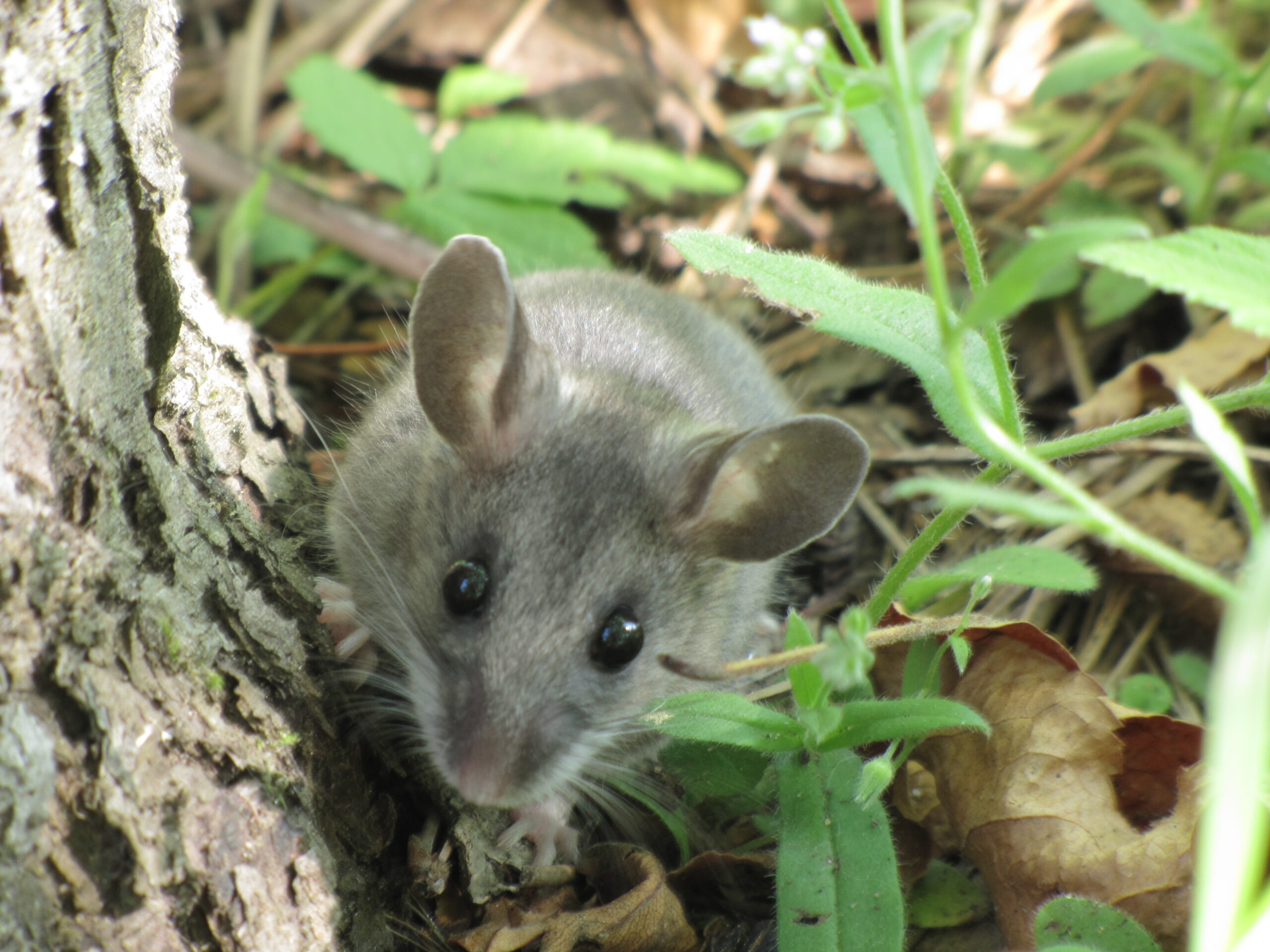
- Two-tone color: Reddish-brown to grayish-brown back with a sharp, clean break to a white belly, white feet, and white underside of tail
- Bicolored tail: Dark on top, white below — the single most reliable field identification feature
- Very large eyes and ears relative to body — noticeably large even at a quick look
- Most common in attics, outbuildings, and rural structures, not kitchen areas
Norway Rat
- Heavy, thick body; blunt muzzle; small ears relative to body
- Brown or gray coat with paler underside
- Thick, scaly tail shorter than body length
- Leaves large, greasy rub marks along frequently used runways
- Most common in basements, crawlspaces, along foundation walls, under slabs, in sewers
Roof Rat
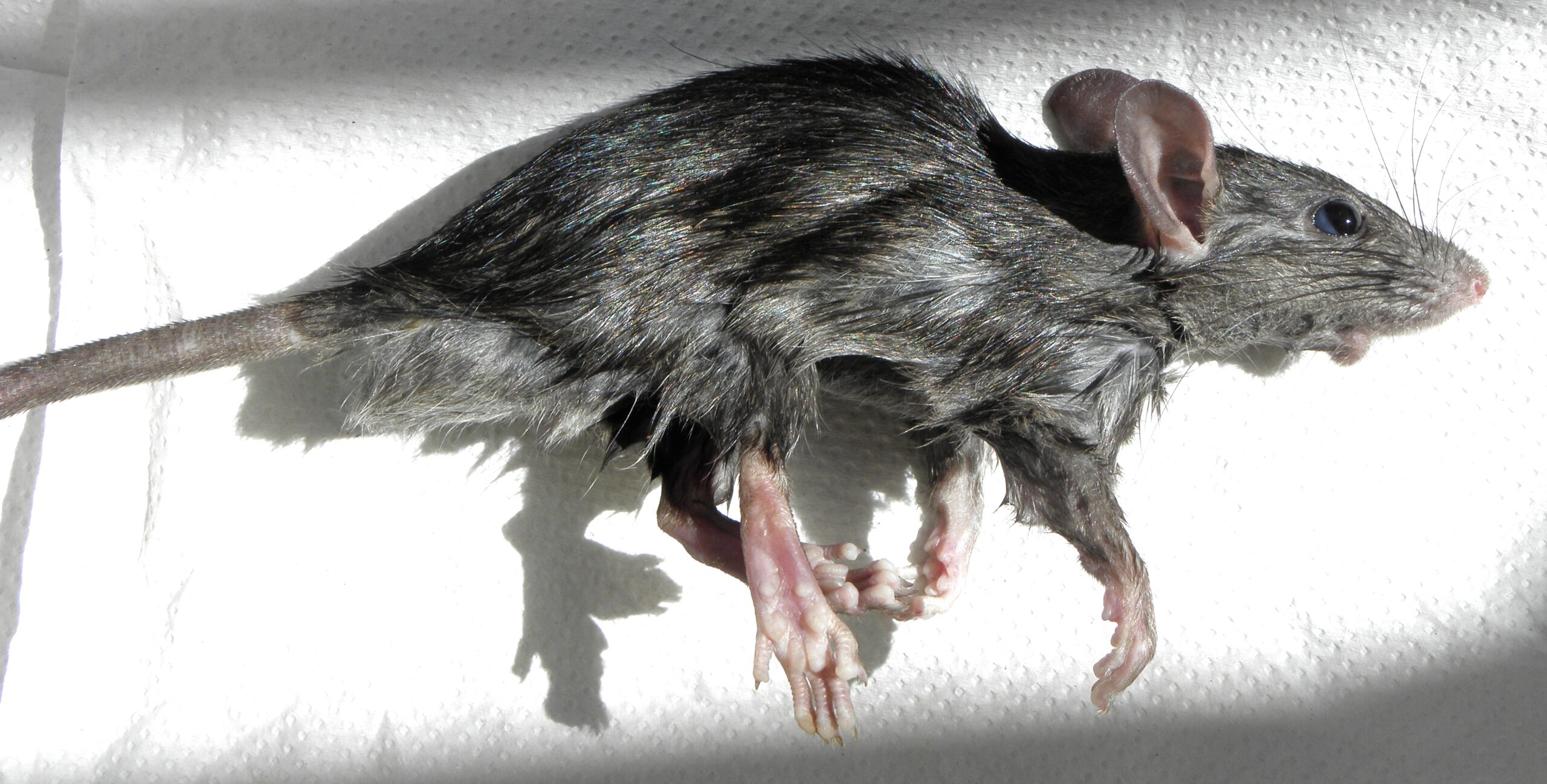
- Slender, lighter body compared to Norway rat; pointed muzzle
- Dark gray to black coat, lighter below
- Long, thin tail — longer than body length
- Large, naked ears
- Prefers elevated harborage: attics, rafters, tree canopies, vines on structures
- Rare in Oklahoma City Metro. What most Oklahoma City homeowners call an “attic rat” is almost always a Norway rat, not a roof rat. Roof rats are established in Gulf Coast cities but have very limited presence in central Oklahoma. If a rat is in an Oklahoma City attic, it is Norway rat until confirmed otherwise.
Tail: A Reliable Identifier
Tail characteristics are diagnostic for all four species:
- House mouse: Uniformly dark, hairless, roughly equal to body length
- Deer mouse: Bicolored — dark on top, white or pale below. This alone identifies a deer mouse.
- Norway rat: Thick, scaly, shorter than body length
- Roof rat: Long and thin, longer than body length
Entry Points: What Gap Size Tells You
Entry gap size is one of the most useful pieces of evidence when inspecting for rodents.
- 1/4 inch gap: Mice (house mouse, deer mouse). A gap the diameter of a standard pencil is enough.
- 1/2 inch gap: Roof rat. Less common in Oklahoma City.
- 3/4 to 1 inch gap: Norway rat.
If all your exterior gaps are small (1/4 inch), you almost certainly have mice, not rats. If you find a 1-inch or larger gap at the foundation, utility entry, or drain pipe, rats are plausible.
Rats tend to use lower entry points — foundation gaps, utility penetrations near grade, drain lines, crawlspace vents. Mice use the full height of the structure. Deer mice most commonly enter through roofline vents and soffit gaps into attics.
Rub Marks and Smears: Rats Leave a Dirty Signature
One of the most reliable signs that you have rats rather than mice is the condition of the entry point and runways around it.
Rats produce heavy grease smears. Rat fur carries oils and body grease that transfer to any surface they pass repeatedly. Around an active rat entry hole, you will typically see dark, oily smear marks on the wall, pipe, or wood framing surrounding the opening. Along rat runways — the paths they travel along walls, pipes, and joists — the same dark smearing accumulates over time. Active runways often have a dirty, blackened appearance at contact points. The entry hole itself is frequently gnawed larger than the minimum needed, and the surrounding surface is stained.
Mice leave much cleaner entry points. Mouse entry holes are small and precisely gnawed. Smear marks may appear over a very long-established runway, but they are faint compared to rat smears. A clean, small gnaw hole without heavy surrounding staining points to mice.
[IMAGE: Close-up of active rat entry hole at a foundation pipe penetration showing dark grease smear marks on surrounding framing. Caption: “Norway rat entry — note the dark oily smear marks on the wood around the hole. Mice leave much cleaner entry points.”]
[IMAGE: Norway rat runway along a floor joist showing accumulated grease smearing at joist contact points. Caption: “Active rat runway — dark smear marks where the rat travels the same path repeatedly.”]
The combination of hole size and smear condition narrows identification quickly: large hole (3/4 inch+) with heavy smearing = Norway rat. Small hole (1/4 inch) with light or no smearing = mice.
Behavior Differences That Affect Treatment
Understanding how each species behaves changes how you approach control.
Neophobia (Fear of New Objects)
Norway rats are strongly neophobic — they are wary of anything new in their environment and may avoid a freshly placed trap or bait station for 24 to 72 hours or longer. This is why rat control requires patience. Unset traps placed for 3 to 5 days before activation (“pre-baiting”) are more effective than immediately armed traps with rats.
Mice (house and deer) are the opposite — they are curious and will investigate new objects quickly, often within hours. Snap traps and bait stations placed along mouse runways typically produce catches within the first night.
Roof rats are moderately neophobic — more cautious than mice but somewhat less so than Norway rats.
Home Range
Rats (both Norway and roof rat) operate within roughly 100 to 300 feet of their nest. Norway rats tend toward the lower end of that range — typically within about 100 feet — while roof rats range somewhat farther, up to 300 feet. Either way, a rat infestation is concentrated and the source is nearby.
House mice have an even tighter range — typically within 10 to 20 feet of their nest. Mouse activity is very localized to the nest site, which is why you can have mice in a kitchen wall without any sign of them in an adjacent room.
Deer mice have a wider natural range of 1 to 3 acres but concentrate activity near harborage once established in a structure.
Water Needs
Rats require a reliable water source — approximately 1 ounce per day for a Norway rat. Finding a rat infestation often means finding a water source nearby: a leaking pipe, condensation, a pet water bowl, or drainage.
Mice get most of their water from food and can survive without a free water source. This is part of why mice are so adaptable to dry indoor environments.
Movement Patterns
Rats run established runways and follow the same routes repeatedly. Grease rub marks on walls and pipes are left by rat fur and are a reliable indicator. Norway rats hug walls and run along the base of structures.
Mice also run along walls but range more freely. They are agile climbers. Deer mice are particularly good climbers and reach attic spaces through roofline penetrations.
Health Risks: Not All Rodents Are Equal
This is where species identification has real consequences.
Deer Mouse — Highest Health Risk in Oklahoma City
The deer mouse is the primary carrier of Sin Nombre hantavirus, which causes Hantavirus Pulmonary Syndrome (HPS). The CDC documents HPS with a case fatality rate of approximately 36 to 40 percent. Transmission is through inhaling dust from dried deer mouse droppings, urine, or nesting material — not through direct contact. You do not need to touch or handle a deer mouse to be exposed.
If you have droppings in an outbuilding, barn, shed, or attic of a rural-adjacent property, treat them as potentially from a deer mouse. Follow hantavirus-safe cleanup protocol: ventilate the space for 30 minutes, wear an N95 or better respirator and rubber gloves, wet down droppings with 10% bleach solution before handling, and double-bag waste. Do not dry sweep or vacuum.
For large accumulations in attics or crawlspaces, call or text Alpha Pest Solutions at (405) 977-0678 — large-scale cleanup should not be DIY without proper equipment.
Norway Rat
Norway rats are associated with leptospirosis (a bacterial infection transmissible through urine-contaminated water or soil), salmonellosis, and rat-bite fever. They also carry fleas, mites, and ticks. Norway rat infestations in basements, crawlspaces, and drain systems represent a real but different health risk than hantavirus — serious, but with lower case fatality and lower transmission risk from incidental exposure.
House Mouse
House mice carry salmonellosis, hantavirus (different strains than deer mice; less consistently associated with severe HPS), and are a significant allergen source. Mouse dander and urine proteins are among the most common indoor allergens and can contribute meaningfully to asthma and allergy symptoms, particularly in children. House mice are less acutely dangerous than deer mice but should not be dismissed as a health non-issue.
Roof Rat
Health risks similar to Norway rat: leptospirosis, salmonellosis, fleas. Rare in Oklahoma City.
Which Rodent Do You Have in Oklahoma City?
Urban Oklahoma City, Edmond, Moore, Midwest City, Del City — established neighborhoods:
- House mouse is the most common. Found in walls, kitchens, under appliances, in garage storage.
- Norway rat is the second most common, especially in older areas of Oklahoma City (Midtown, Nichols Hills area, Capitol Hill, older southeast Oklahoma City), near restaurant districts, and in areas with older sewer infrastructure.
- Deer mouse possible but less common in dense urban areas.
- Roof rat: rare to absent.
Suburban fringe — Edmond edges, Yukon, Mustang, eastern Norman, Choctaw, Blanchard, Tuttle:
- House mouse: common.
- Deer mouse: significantly more common than in urban Oklahoma City. Properties adjacent to fields, wooded areas, and creek corridors have regular deer mouse pressure.
- Norway rat: present, particularly in older or more developed nodes.
- Roof rat: rare.
Rural and semi-rural properties throughout the metro area:
- All four species possible, with deer mouse most important to rule out given hantavirus risk.
- Norway rat common near grain storage, livestock operations, and structures with moisture and harborage.
Quick rule of thumb for most Oklahoma City residents:
- Small droppings, grain of rice size, in a kitchen or wall? → House mouse.
- Small droppings in an outbuilding, shed, attic, or rural property? → Treat as deer mouse until confirmed otherwise.
- Large droppings (Tic Tac size, blunt ends) anywhere? → Norway rat.
- Rat activity in an attic? → Norway rat, not roof rat, in Oklahoma City.
When to Call or text Alpha Pest Solutions
Correct identification matters because it changes the treatment approach:
- Mice respond to snap traps and bait stations quickly; treatment timelines are faster.
- Rats require pre-baiting, larger stations, attention to water sources, and more patience.
- Deer mice require hantavirus-safe handling protocols during cleanup regardless of the control method used.
If you are unsure what you have, a free inspection from Alpha Pest Solutions identifies the species and assesses the scope. We serve Oklahoma City, Edmond, Norman, Moore, Midwest City, Del City, Yukon, Mustang, and the surrounding Oklahoma City metro.
Call or text (405) 977-0678 or email service@pestalpha.com. Monday through Saturday, 7am to 7pm.
Related Library Pages and Services
- House Mouse
- Deer Mouse
- Norway Rat
- Rodent Control Service
- Attic Remediation
- Wildlife and Rodent Proofing
- Wildlife Control
Rodent identification data sourced from CDC (Centers for Disease Control and Prevention), OSU Extension (Oklahoma State University Cooperative Extension), and NPMA (National Pest Management Association) guidelines.